How to Accept Card Payments Without a Business

No LLC or EIN? You can still take cards as a sole proprietor. Compare tap to pay, payment links, P2P apps and readers, plus the tax rule most sellers miss.
Payments

Sep 29, 2026

Main topics
See article summary
  • Selling on your own makes you a sole proprietor by default, so you can take cards without an LLC or state filing.
  • Use your Social Security number to start, and get a free IRS EIN once you hire or form a partnership.
  • Ask your city, county, and state revenue department about licenses and sales tax before your first market day.
  • Card processors report card sales to the IRS at any amount, and you must report all sales income anyway.
  • JIM takes cards on your phone at 1.99% per Tap to Pay sale, so a $300 sale costs $5.97.

You can accept card payments without a registered business. Once you sell goods or services on your own, you count as a sole proprietor, and you can sign up for a payment app with your name and Social Security number (SSN).

The U.S. Small Business Administration (SBA) confirms that if you do business under your legal name, you won't need to register anywhere. The part you can't skip is taxes, and it starts with your first sale.

Can you accept credit cards without a business?

Yes, because the law already treats you as one. The SBA says you're automatically considered a sole proprietorship if you do business activities without registering as any other kind of business. The IRS defines a sole proprietor as someone who owns an unincorporated business by themselves. The weekend candle table, the freelance logo job, and the dog walking gig all count.

What you are
A sole proprietor. No filing, no fee, and no state paperwork to start selling.
What you use
Your legal name and SSN, both for payment apps and for taxes.
What you file
Business profit on Schedule C and self-employment tax on Schedule SE, both with your Form 1040.
What you give up
Liability protection. The SBA notes your business debts and your personal assets are not separate.

That last row is the real tradeoff. For a low-risk, one-person activity, the SBA itself calls a sole proprietorship a good way to test a business idea. Once a bigger contract, a hire, or a partner raises what a dispute could cost you, read LLC vs sole proprietorship before you grow.

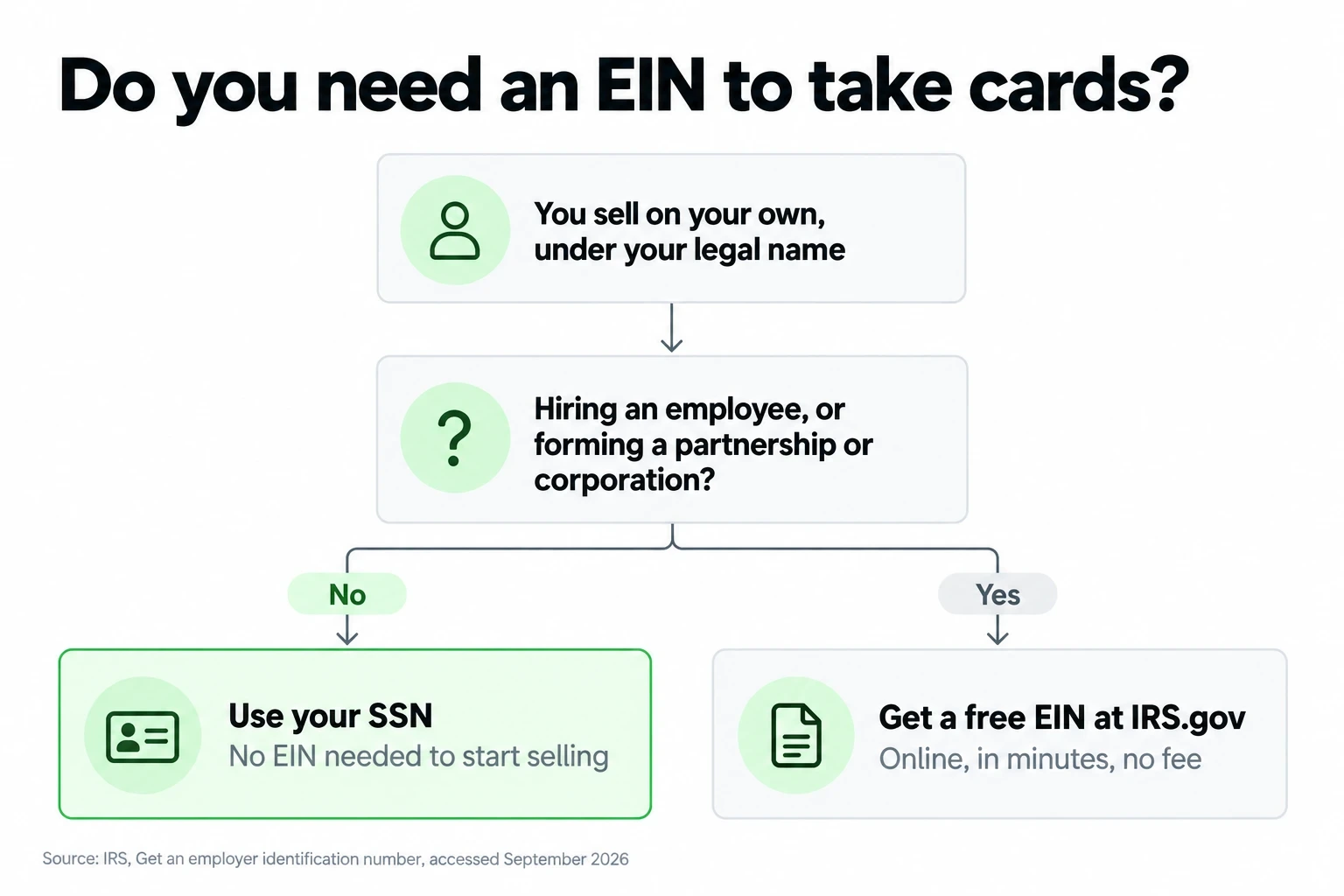
Do you need an EIN, or can you use your SSN?

Use your SSN to start. An Employer Identification Number (EIN), the federal tax ID for a business, becomes necessary only when your setup changes. The IRS says you generally need an EIN to hire employees, run a partnership or corporation, or change your structure or ownership.

Your situationEIN needed?
Selling alone under your legal nameNo, your SSN works
Hiring your first employeeYes
Running a partnership or corporationYes
Opening a business bank account under a trade nameUsually, the SBA pairs it with a DBA
Decision tree: sell alone under your legal name and use your SSN, or get a free EIN if you hire or form a partnership

The EIN costs nothing. The IRS issues it online in minutes and warns that "you never have to pay a fee for an EIN," so skip any site that charges for one. Forming an LLC first? File with your secretary of state before you apply, or the IRS says your application may be delayed.

Do you need a business license or a sales tax permit?

Check before your first market day, because the answer comes from your state, county, and city, not from Washington. The SBA says the licenses you need depend on your business activities and location, and it sends you to your state's Department of Revenue to find out whether you need a state tax ID.

City or county
Ask the clerk whether your activity needs a general business license or a home-based business permit.
State revenue department
If your state taxes what you sell, register for sales tax before you collect it.
Regulated work
Food, beauty, and other licensed trades can need a state license whatever your structure. The SBA notes industry rules vary by state.
Trade name
Selling under a name other than your own? The SBA says most states require you to register it as a DBA.
Local examples, not nationwide rules
Verify every requirement with the agency that covers your address.

What are the ways to accept card payments as an individual?

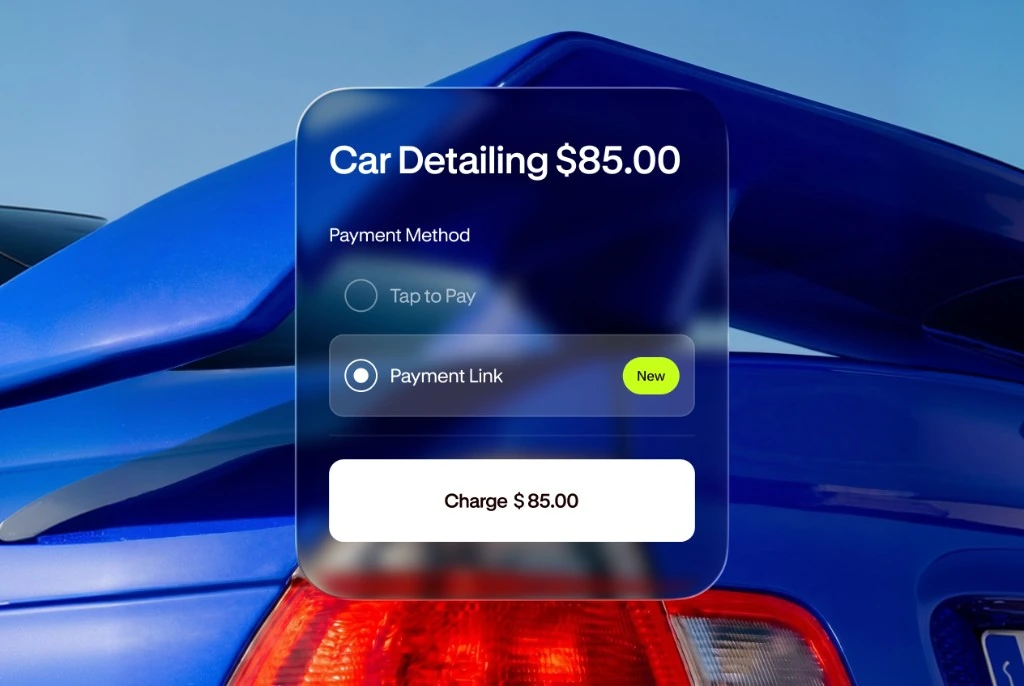
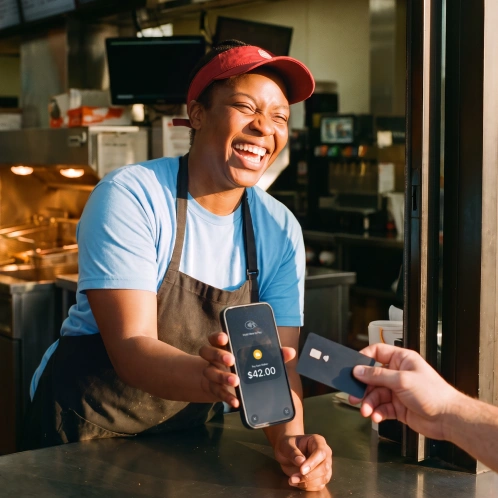
Pick by where your customer stands. For face-to-face sales, a tap to pay app on your phone is the cheapest setup. For anyone who isn't in front of you, send a payment link.

OptionBest forWhat you needWatch out for
Tap to pay appMarkets, pop-ups, house callsA phone with NFCBuyer needs a contactless card or wallet
Payment linkDeposits, custom orders, DMsThe buyer's phone number or emailHigher fee than in person
P2P app business profileBuyers who use the same appA business profile or accountPersonal accounts are not for sales
Card readerBusy counters with long linesA reader you buy, plus an appUpfront cost and charging

For a deeper look at hardware-free methods, see how to accept credit card payments without a machine. Already running a registered shop? The small business guide to accepting credit cards compares tools by use case. This page stays on the question that comes first: what you need as a person, not a company.

Can you use a personal payment app account for sales?

No. The big peer-to-peer (P2P) apps separate personal money from sales, and their terms move sellers to business tools:

Venmo
The user agreement bars personal accounts from business transactions, unless the payment is marked for goods and services or goes to a business profile.
Cash App
Its business FAQ says personal accounts should not be used to accept business payments.
PayPal
The user agreement requires a business account if you use PayPal primarily for business, even when your business is not incorporated.

So the fair comparison is business tool against business tool. Here is what a $300 in-person card tap costs on each:

ProviderTap to Pay feeFee on $300You keep
JIM1.99%$5.97$294.03
Venmo business profile2.29% + $0.09$6.96$293.04
Cash App Business3%$9.00$291.00

Source: Venmo and Cash App official websites, accessed September 2026. JIM fee from jim.com/pricing. The P2P apps also take app-to-app payments at separate rates, which only work when your buyer has the same app.
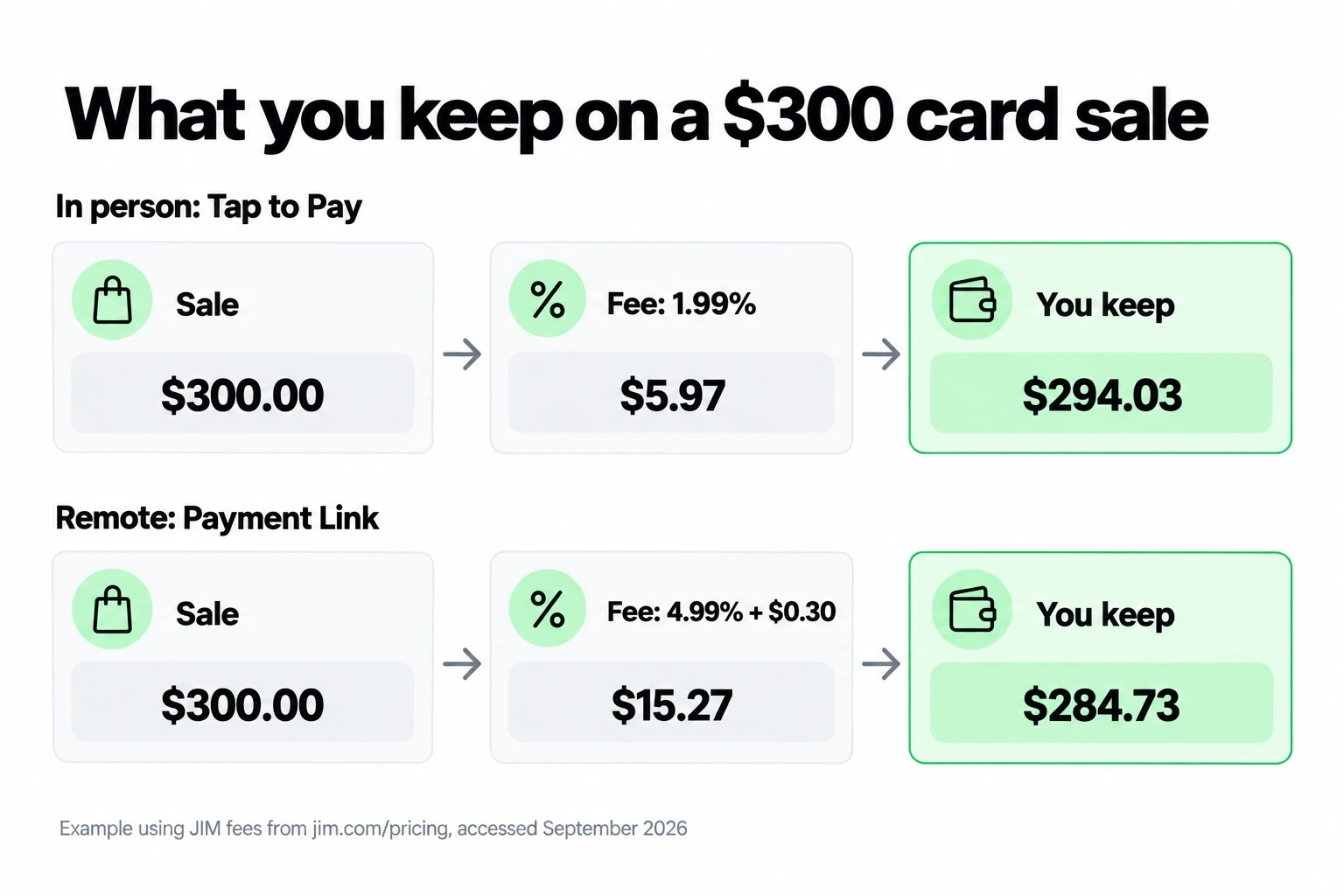
Fee example on a $300 sale: $5.97 with Tap to Pay at 1.99%, $15.27 with a payment link at 4.99% plus $0.30

Do you pay taxes on card payments without a business?

Yes, on every dollar of sales income. The IRS says that no matter the amount, you must report all income from selling goods or services on your tax return, with or without a Form 1099-K.

Card sales
Your card processor sends a Form 1099-K no matter how many payments or how much.
Payment apps and marketplaces
For tax year 2026, they must file only above $20,000 in payments and more than 200 transactions, per the IRS Form 1099-K instructions revised December 2026. Your state can set a lower threshold.
Filing trigger
You must file a return once your net earnings from self-employment reach $400.
Quarterly tax
The IRS says self-employed people generally pay estimated tax each quarter with Form 1040-ES.

In practice, even a small weekend of card sales can land on a 1099-K. Keep receipts for supplies and fees: the gross amount on the form does not subtract fees or refunds, and the IRS lets you deduct those when you file. Freelancers who also get client forms can compare methods in freelancer payment methods.

What do you need to sign up for JIM without a business?

You need your own ID, not company papers. JIM serves solo sellers and single-member LLCs in all 50 states, and its seller profile checks who you are:

Who qualifies
Anyone 18 or older who can sell in the United States, in a supported industry.
What to have ready
A government photo ID, your date of birth, an address that matches the ID, a business category, and a short description.
Your phone
An iPhone or Android phone with NFC and current software, not jailbroken or rooted.
Bank account
Not required to sell. You need one only to cash out by ACH.
Tax ID
Form 1099-K carries your SSN or EIN. JIM handles it in tax reporting, not in the signup steps.

JIM does not approve every type of business, so check the unsupported industries list before you apply. If your work is on the approved side, you can take Tap to Pay sales at 1.99% and send a Payment Link at 4.99% + $0.30, and each sale loads your JIM Card, a Visa prepaid card, in seconds. JIM also builds a free website with a catalog and checkout when you sign up. Instant settlements subject to terms. JIM is a financial technology company, not a bank; banking services are provided by Lead Bank, Member FDIC.

You saw the numbers: a $300 craft fair sale costs $5.97 with JIM Tap to Pay, against $6.96 to $9.00 on the P2P business profiles. Starting a side hustle from zero? The side hustle guide covers validation and pricing. Ready to take your first card? Download JIM and set up my seller profile.


Frequently Asked Questions

Can I accept credit card payments as an individual?

Yes. When you sell on your own, you operate as a sole proprietor, and you can take cards with a tap to pay app or a payment link under your own name. No LLC is required.

Do I need an LLC to accept credit cards?

No. An LLC adds liability protection, not the ability to take cards. Payment apps built for solo sellers accept sole proprietors, so form an LLC when your risk grows, not to unlock payments.

Can I use my SSN instead of an EIN to get paid?

Yes. A sole proprietor with no employees can use a Social Security number. Get a free EIN from the IRS once you hire, form a partnership or corporation, or open a business bank account under a trade name.

Do I have to pay taxes on card payments if I am not a business?

Yes. The IRS requires you to report all income from selling goods or services, whether or not you receive a Form 1099-K. You also file a return once net self-employment earnings reach $400.

What is the Form 1099-K threshold for 2026?

Payment apps and online marketplaces must file when payments top $20,000 across more than 200 transactions. Card processors report card payments at any amount, and some states set lower thresholds.

Can I use a personal payment app account for sales?

Not for regular sales. The major peer-to-peer apps require a business profile or business account for payments for goods and services, even when your business is not incorporated.

How much does JIM charge to accept a card payment?

JIM charges 1.99% per Tap to Pay sale and 4.99% + $0.30 per Payment Link sale, with no monthly fee and no hardware to buy.

Related content

Young online soap seller reviewing tax forms and receipts at his home workshop table
Flexible Options

1099-K for Payment App Sellers: 2026 Threshold and Rules

Lash artist confirming a client appointment on her phone in her small beauty studio, treatment chair behind her
Flexible Options

How to Take Deposits From Clients and Stop No-Shows

Handyman typing a follow-up message to a client on his phone from the seat of his pickup truck
Flexible Options

How to Ask a Client for Payment (With Templates)

Flexible Options

What is meta pay? A US seller's checkout guide

Sell and get paid in seconds with Jim

Get Jim
This is a plain white button background with no text or meaningful visual content. Screen readers should skip it; the button’s label carries the meaning.
Barista in green apron holds pink and mango smoothies in clear cups with strawsLaughing fast-food worker holds phone showing $42.00 contactless payment to customer at drive-thruWoman in yellow sweatshirt dispenses frozen yogurt at topping bar in sunlit shopWoman in orange work shirt unloads cardboard boxes from white delivery van on sunny streetHairstylist Keisha trims client hair with scissors in busy sunlit salonPizza maker slides pizza into wood-fired brick oven in bright kitchen