How to start a pickle business: from brine to brand
See article summary
- A small-scale pickle business costs $1,500 to $5,000 to launch, covering kitchen, ingredients, packaging, and permits.
- Pickles are acidified foods under FDA rules, requiring facility registration, 21 CFR Part 114 compliance, and Better Process Control School certification.
- Most states prohibit selling pickles from home under cottage food laws, so a licensed commercial kitchen is typically required.
- Price each jar using a COGS formula, then apply a 100% wholesale markup for a 50% gross margin.
- JIM lets you accept card payments at farmers' markets for a flat 1.99% per tap with no hardware.
A pickle business in the U.S. typically costs $1,500 to $5,000 to launch at a small scale and requires FDA registration as an acidified food producer. Demand is steady across restaurants, grocery shoppers, and home cooks, with the U.S. pickle market valued in the billions.
Your path runs from validating your concept through licensing, production setup, and pricing to your first wholesale order.
Step 1: How much does it cost to start a pickle business?
A small-scale pickle business launches for $1,500 to $5,000, covering commercial kitchen time, ingredients, packaging, and permits. The exact figure depends on your state's licensing fees and whether you rent or share a kitchen.
Start by visiting local farmers' markets and specialty food stores. Note which pickle types are popular, what price points they carry, and how they are packaged. Also, check Google Trends for search interest in niche flavors like "spicy dill" or "sweet horseradish" in your area.
Analyze your competition
Look at the pickle selection in at least three local grocery stores. Identify the big national brands and any local players. Many new owners focus only on local rivals and forget that online brands with strong social media followings are also their competitors.
Estimate your startup costs
Your initial investment can be modest if you start small. A common mistake is to underestimate packaging expenses, so price out jars and labels carefully. Budgeting for these initial costs gives you a clear financial picture from day one.
- Commercial Kitchen Rental: $25 to $75 per hour
- Initial Ingredients: $200 to $500
- Packaging (jars, lids, labels): $300 to $600 for a first run
- Permits & Licenses: $100 to $1,000+, depending on your state's laws
With these figures, a small-scale launch could range from $1,500 to $5,000. This investment sets the foundation for your production and legal compliance.
The 4-point Jar-Test for validation
Before you commit money, score your concept on four dimensions unique to artisan pickles:
- Flavor gap: Does a flavor profile exist in your market that nobody else fills? Sample 10 competing jars and note what is missing.
- Price ceiling: Can you produce a jar for $2.50 or less and still hit a $5.00 wholesale price? Run the numbers before you buy ingredients.
- Shelf appeal: Does your label and jar shape stand out on a crowded market table? Compare yours against five competitors side by side.
- Production feasibility: Can you hit a shelf-stable pH of 4.6 or below consistently in a shared kitchen? This is non-negotiable for safety.
Here are 4 immediate steps to take:
- Visit three local stores to analyze their pickle sections.
- Research your state's specific cottage food laws online.
- Get quotes for jars and labels from two different suppliers.
- Create a simple spreadsheet to budget your initial startup costs.
Step 2: What licenses and registrations does the FDA require for pickles?
Pickles are acidified foods under federal law, which means you must register your facility with the FDA, file your process with the agency, and complete Better Process Control School certification. Your state and local health department add their own permit requirements on top.
First, protect your personal assets by forming a Limited Liability Company (LLC). You can file this with your Secretary of State for about $50 to $500. This structure provides liability protection and simpler pass-through taxation compared to a corporation, which is a good fit for a new business.
With your business entity established, you must address food safety regulations. Register your production facility with the U.S. Food and Drug Administration (FDA) online at no cost. There is no fee for registration or renewal. Since pickles are acidified foods, you must also file your scheduled process with the FDA using Form FDA 2541e and comply with 21 CFR Part 114, the federal regulation that governs acidified foods. A frequent misstep is ignoring these rules, which can halt your business.
Complete Better Process Control School
FDA regulations require acidified food producers to complete Better Process Control School (BPCS) certification before beginning commercial production. This training covers the safe processing of acidified foods and small-batch canning procedures. Providers include Cornell University, UC Davis, and the University of Georgia. The acidified foods portion typically costs $350 to $1,000 depending on the provider and whether you attend in person or online. Plan for this cost and time in your startup budget.
Can you sell pickles from home under cottage food laws?
In most states, no. Cottage food laws generally exclude acidified and canned foods like pickles because of botulism risk. A few states, such as Wisconsin and Indiana, allow limited pickle sales under cottage food exemptions, but most require a licensed commercial kitchen. Check your state's department of agriculture or health for the specific rules that apply to your area.
Next, contact your local health department for a food handler's permit and to understand their kitchen requirements. These permits can cost $100 to $400 and take 4 to 8 weeks to process. You will also need a general business license from your city or county to operate legally.
Here are 4 immediate steps to take:
- File for an LLC with your state's Secretary of State.
- Register your food facility on the FDA's online registration portal.
- Enroll in a Better Process Control School course for acidified foods.
- Call your local health department about food permit applications.
Step 3: What insurance does a pickle business need?
General liability insurance with product liability coverage is your core policy, and a $1 million policy is standard for small food producers. Many farmers' markets require proof of insurance before they let you sell.
Protecting your business starts with the right insurance. Your main policy will be General Liability, which should include Product Liability coverage. A $1 million policy is standard. For illustration, annual premiums for a small food operation commonly fall in the $500 to $1,500 range, though your actual cost depends on your location, revenue, and coverage details. Many farmers' markets require this before you can sell.
Some new owners mistakenly believe their homeowner's policy offers protection. It does not cover business activities, so a separate commercial policy is necessary. Depending on your setup, you may also need other coverage.
- Commercial Property Insurance: Covers your equipment and inventory.
- Commercial Auto Insurance: Needed if you use a vehicle for deliveries or business errands.
- Workers' Compensation: Requirements vary by state. Some states require coverage with your first employee, others set the threshold at three or more, and Texas does not mandate it for private employers at all. Check your state's specific threshold through the U.S. Department of Labor's workers' compensation resources, which links to each state's workers' comp board.
Understand your unique risks
Pickle production has specific risks, such as bacterial contamination or spoilage from improper acidification. You also have to consider physical hazards like glass shards from broken jars. The right insurance protects you from liability claims related to these issues.
When you're ready for quotes, consider providers that work with food businesses, such as the Food Liability Insurance Program (FLIP), Insureon, or The Hartford. They understand the industry's risks better than a general agent and can find appropriate coverage.
Here are 4 immediate steps to take:
- Get a quote for a $1 million general and product liability policy.
- Check your local farmers' market for its insurance requirements.
- Contact an insurance provider that specializes in food businesses.
- Review your state's workers' compensation laws if you plan to hire help.
Step 4: Where do you produce pickles and what equipment do you need?
Your production space must be a licensed commercial kitchen, and a shared-use kitchen is the most affordable starting point. You need commercial-grade equipment, including a calibrated pH meter, because health departments will not approve home kitchen tools.
A shared-use kitchen is a great start. Look for a space around 200 to 500 square feet zoned for commercial use. This setup avoids the high cost of a private facility and often includes some basic equipment.
When you review a lease, you might want to ask for a one or two-year term instead of a longer commitment. Landlords will want to see your LLC formation documents and proof of insurance, so have those ready. This preparation shows you are a serious operator.
Stock your kitchen
Many new owners try to use home kitchen tools, but health departments require commercial-grade equipment. This gear is built for heavy use and is easier to sanitize properly. Your initial purchases set the stage for safe, efficient production.
- pH Meter: $50 to $200 to ensure safety and consistency.
- Commercial Grade Stock Pots (20+ quarts): $150 to $400 each.
- Food Processor or Mandoline Slicer: $300 to $800 for uniform cuts.
- Canning Supplies & Heat Sealer: $200 to $500 for an initial setup.
For supplies, check out WebstaurantStore or a local restaurant supply depot. When you buy jars, a full pallet might have 2,000 units. This bulk purchase lowers your cost per jar but requires significant storage space. Balance your budget with your available room.
Here are 4 immediate steps to take:
- Tour two local commercial kitchens to compare space and rates.
- Price out a pH meter and a 20-quart stock pot from WebstaurantStore.
- Ask a potential landlord about a one-year lease term.
- Get a quote for a half-pallet of your chosen jars and lids.
Step 5: How do you accept payments at farmers' markets?
You need to accept cash and cards at markets, and card acceptance matters more than ever as cash-carrying customers decline. A flat-rate mobile payment solution with no hardware cost keeps your transaction fees predictable.
At markets, you need to accept cash and cards. For wholesale orders to local shops, you might send an invoice with Net 30 payment terms. This means the business has 30 days to pay you after receiving your pickles.
Many new owners get tripped up by high transaction fees that eat into profits. When you choose a payment solution, look for low per-transaction rates and no monthly fees. Portability is also a major factor for selling at different locations.
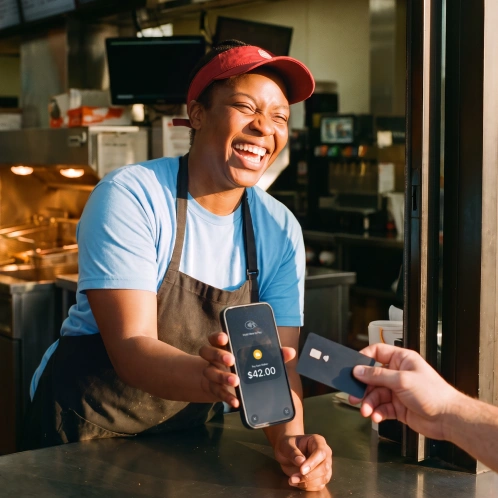
Traditional processors often charge 2.5% to 3.5% per transaction and may require purchasing a card reader. JIM offers a way to accept debit, credit, and digital wallets directly through your smartphone with no extra hardware. You pay a flat 1.99% per Tap to Pay transaction, and your funds are available on your JIM card as soon as the sale completes. For a small-scale pickle vendor selling $8 jars at a busy farmers' market, that difference adds up over a season.
- Get Started: Download the JIM app on your NFC-enabled phone.
- Make a Sale: Type the sales amount, hit sell, and ask your customer to tap their card or device on your phone.
- Access Funds: Your money is available right on your JIM card as soon as the sale is done. No waiting for bank transfers.
Here are 3 immediate steps to take:
- Compare transaction fees from two different payment providers.
- Decide if you will offer Net 30 terms for any wholesale clients.
- Download the JIM app to test the payment flow on your phone.
Step 6: How do you fund a pickle business?
Most pickle businesses start with personal savings, and an SBA Microloan is the most accessible outside capital for food startups under $50,000. Plan for $5,000 to $15,000 in working capital to cover your first six months.
Find the right funding
Most pickle businesses start with personal savings. If you need outside capital, an SBA Microloan is a strong option. These loans go up to $50,000 through the Small Business Administration (SBA) Microloan program, with interest rates generally between 8% and 13% set by intermediary lenders.
You will need a solid business plan to qualify for any loan. You might also consider platforms like Kiva, which offers 0% interest crowdfunded loans. Also, look for a local Community Development Financial Institution (CDFI). Many have programs specifically for food startups. A mistake some new owners make is aiming for a large bank loan, which is often unnecessary at this stage.
Manage your working capital
Plan to have at least $5,000 to $15,000 in working capital to cover your first six months. This money handles ongoing costs like ingredient restocks, kitchen rent, insurance payments, and marketing. It is your operational safety net before sales become consistent.
To manage these funds properly, open a separate business bank account right away. This keeps your personal and business finances distinct, which makes bookkeeping and tax time much simpler. It also presents a more professional image to suppliers and lenders.
Here are 4 immediate steps to take:
- Research an SBA microlender in your area online.
- Draft a 6-month budget for your working capital needs.
- Open a dedicated business checking account.
- Find a local CDFI and check for food business loan programs.
Step 7: How do you hire and manage your team?
Your first hire is a part-time Kitchen Assistant at $15 to $20 per hour, and you should classify them as a W-2 employee from the start to avoid IRS penalties. Hire one part-time person for every $50,000 to $75,000 in additional revenue to keep labor costs proportional.
Build your production team
As you grow, you cannot do everything yourself. Your first hire will likely be a part-time Kitchen Assistant. This person will handle vegetable prep, jar sanitization, and packing. Expect to pay between $15 and $20 per hour, and they must have a Food Handler's Permit.
Some new owners misclassify their first workers as independent contractors to avoid payroll taxes. This can cause serious issues with the Internal Revenue Service (IRS). The IRS provides guidance on employee versus independent contractor classification, and you can request a formal determination using Form SS-8. It is safer to treat them as W-2 employees from the start, even if they only work a few hours a week.
Once you start selling at multiple markets, you might need Market Sales Staff. Their job is to run the booth and engage customers. A similar hourly wage works well here. You could also offer a small commission, like 1 to 2% of their daily sales, as a motivator.
Streamline your daily workflow
A good rule of thumb is to handle the first $50,000 in annual revenue yourself. After that, plan to hire one part-time employee for every additional $50,000 to $75,000 in sales. The math works because a part-time worker at $15 to $20 per hour for 20 hours a week costs roughly $15,600 to $20,800 per year. Against $50,000 to $75,000 in new revenue, that keeps your labor cost at 20% to 42% of the incremental sales, a sustainable ratio for a small food producer. This keeps your labor costs manageable as you scale.
To manage schedules, look at software like Homebase or When I Work. Both offer free plans for small teams and make it easy to track hours. Also, create simple, written Standard Operating Procedures (SOPs) for your recipes and cleaning tasks to ensure consistency no matter who is working.
Here are 4 immediate steps to take:
- Write a job description for a part-time Kitchen Assistant.
- Research your state's rules on classifying employees versus contractors.
- Sign up for a free plan on Homebase or When I Work to see the features.
- Draft a one-page cleaning checklist for your production process.
Step 8: How do you market pickles and find customers?
Farmers' markets are your starting point, where offering 50 to 100 samples per day at a 10 to 15% conversion rate builds your first customer base. Expand into wholesale by approaching local delis and specialty shops with a sell sheet.
Build your direct sales channels
Start at farmers' markets. Plan to offer 50 to 100 samples per day. A 10 to 15% conversion rate from sampler to buyer is a practical target based on common farmers' market experience. Track your actual rate so you know what works. Your booth should be visually appealing, with clear pricing and branding that tells your story.
For online sales, use Instagram and TikTok. Many new owners post blurry photos from a poorly lit kitchen. Your pickles must look crisp and vibrant, so use good natural light. You might also partner with local food bloggers by offering them free products for a post.
Expand into wholesale
Approach local delis and specialty food shops. Bring a sample kit and a one-page sell sheet with your wholesale price, suggested retail price (SRP), and product barcodes. Follow up within a week. Persistence often pays off with small retailers.
Your Customer Acquisition Cost (CAC) is a key metric. If you spend $100 on social media ads and gain 10 customers, your CAC is $10. For direct sales, a CAC under $5 is a good target to maintain profitability.
Here are 4 immediate steps to take:
- Create a one-page sell sheet with your wholesale pricing.
- Plan to give out at least 50 samples at your next market.
- Identify two local food bloggers to contact for a collaboration.
- Calculate your target Customer Acquisition Cost (CAC).
Step 9: How do you price pickles for wholesale and retail?
Your cost per jar is the foundation, and a standard 100% wholesale markup on cost gives you a 50% gross margin. Calculate cost of goods sold by adding ingredients, packaging, labor, and overhead, then dividing by jars produced.
Calculate your cost of goods sold
First, figure out your cost per jar. Add up all direct expenses for a batch: ingredients, jars, lids, and labels. Also, include a portion of your kitchen rent and an estimate for your labor, perhaps $15 per hour. Divide that total by the number of jars you produced.
COGS per jar = (Ingredients + Packaging + Labor + Overhead) / Jars produced
For example, if a batch costs $250 and yields 100 jars, your cost of goods sold (COGS) is $2.50 per jar. Many new owners forget to factor in their own time, which can make their pricing unprofitable from the start. This number is your foundation.
Set your wholesale and retail prices
With your cost per jar figured out, you can set your prices. A standard wholesale markup is 100%, which doubles your cost. In our example, a $2.50 cost per jar would lead to a $5.00 wholesale price. This gives you a 50% gross profit margin.
Retailers then add their own markup, usually 50 to 100%, meaning your pickles might sell for $7.50 to $10.00. If you use premium ingredients or have a unique flavor, you can aim for the higher end of that range. Do not compete only on being the cheapest.
Here are 4 immediate steps to take:
- Calculate your exact cost per jar, including labor and overhead.
- Research the retail prices of three competing pickle brands.
- Set a wholesale price with at least a 100% markup on your cost.
- Decide on a Suggested Retail Price (SRP) for your sell sheet.
Step 10: How do you maintain quality and scale?
Every jar must hold a finished equilibrium pH of 4.6 or below, tested on every batch, and you scale by adding one part-time employee for each $50,000 to $75,000 in new revenue. A dedicated kitchen becomes worth the cost near $100,000 in annual sales.
Your reputation rests on consistency. Every jar must meet the same standard. The most important metric is pH. For safety, the FDA requires acidified foods to have a finished equilibrium pH of 4.6 or below. Use your pH meter on every single batch without fail.
Some producers only rely on taste, but that will not protect you from safety issues. Also, create a simple quality log. Note the pH, batch number, and date for every run. This provides traceability if a problem ever arises.
Plan your growth
Once your quality is locked in, you can plan for growth. Use the rule of thumb from earlier. Hire one part-time employee for every $50,000 to $75,000 in new annual revenue. This keeps your labor costs from outpacing your sales.
When you approach $100,000 in annual sales, it is time to consider a dedicated kitchen or a co-packer who can produce your recipe at scale. This move gives you more control over your production schedule. For managing inventory and recipes as you grow, you might look at software like MarketMan or QuickBooks for your finances.
Here are 4 immediate steps to take:
- Create a quality control log to track the pH of every batch.
- Set a revenue goal, like $100,000, for leasing a dedicated kitchen.
- Research an inventory management software option like MarketMan.
- Run a double-sized test batch to check for consistency issues.
Your next milestone: enroll in Better Process Control School, file your FDA facility registration, and book your first commercial kitchen time this week. When you make your first sales, a simple payment solution helps. JIM turns your phone into a card reader, letting you accept payments for a flat 1.99% fee. It keeps things simple so you can focus on your pickles. Download JIM to get started.
Frequently Asked Questions
How much does it cost to start a pickle business?
Do I need FDA approval to sell pickles?
Can I sell pickles from home?
What license do I need to sell pickles?
How do I keep my pickles safe and shelf-stable?



Sell and get paid in seconds with Jim