How to start a retail business: from idea to opening day

See article summary
- Validate your idea with 50 to 100 potential shoppers before you commit capital.
- Budget $25,000 to $150,000 for startup costs, including inventory, rent, and licenses.
- Form an LLC, get an EIN from the IRS, and secure state and local permits.
- Compare payment processors on transaction fees before you choose one.
- Track return rates and sales per employee to time your growth.
To start a retail business in the U.S. in 2026, you need a validated concept, $25,000 to $150,000 in startup capital, proper licensing, and a plan for funding, staffing, and marketing. The barrier to entry can be low and the potential for profit is high, but that accessibility doesn't guarantee success. Most launches take six to nine months of planning before the doors open.
How do you validate a retail business idea?
Validate your idea by defining your ideal customer, confirming real demand through direct conversations, and analyzing local competitors before you commit capital. This step prevents you from stocking products nobody nearby wants to buy.
First, define your ideal customer. You can use local community forums or simple online surveys to gather feedback. Try to talk with 50 to 100 potential shoppers to confirm there is real demand for your products and learn what they would pay.
With that information, analyze your competition. Many local libraries offer free access to databases like ReferenceUSA, which can help you find other retailers. Visit their stores to observe their pricing, product mix, and overall customer experience.
One common error is focusing only on online rivals. Your biggest challenge is often the shop down the street, so pay close attention to your local market dynamics.
Typical startup cost breakdown
A small retail store can require an initial investment between $25,000 and $150,000. Your location and product type will be the biggest factors. A preliminary budget might look like this:
| Item | Low | High | Notes | |---|---|---|---| | Rent deposit and store build-out | $5,000 | $40,000 | Varies by square footage and TI allowance | | Initial inventory purchase | $10,000 | $75,000 | Largest variable cost for most stores | | Point-of-sale system and software | $1,200 | $5,000 | Hardware plus subscription software | | Business licenses and permits | $500 | $1,500 | State and local fees combined | | Pre-launch marketing | $2,000 | $10,000 | Flyers, ads, grand opening event |
Your validation checklist:
- Draft a one-page profile of your target customer.
- Visit three direct local competitors and document their pricing.
- Create a detailed startup budget using the ranges above.
What licenses does a retail store need?
A retail store needs an LLC or similar business structure, a federal Employer Identification Number, a state seller's permit, a local business license, and a Certificate of Occupancy. Each requirement comes from a different level of government, so plan for processing time.
Most new retail owners form a Limited Liability Company (LLC). This structure protects your personal assets from business debts and lawsuits. Profits pass through to your personal tax return, which simplifies filing. You can file for an LLC through your state's Secretary of State website, which the SBA's state registration directory links to for every state. Filing fees vary widely, from about $50 in some states to $500 or more in others.
Once your business is registered, get a free Employer Identification Number (EIN) from the IRS website. You will need this number for banking and taxes. The online application takes less than 15 minutes to complete.
Navigate state and local requirements
You will need a seller's permit from your state's Department of Revenue to collect sales tax. Also, contact your city or county clerk for a general business license, which typically costs between $50 and $400 annually. For example, New York City business license fees generally range from $100 to $200, while many Texas cities charge $50 to $150. A detail that often catches people by surprise is the processing time; some permits can take 4 to 8 weeks.
Finally, your physical location must have a Certificate of Occupancy from the local building department. This confirms the space is safe for public use. Without it, you cannot legally open your doors to customers.
Steps to get licensed:
- Choose your business structure and file the LLC paperwork with your state.
- Apply for a free Employer Identification Number (EIN) on the IRS website.
- Contact your city clerk's office to get a list of required local permits.
- Check your state's Department of Revenue website for sales tax permit rules.
How much does retail insurance cost?
Retail insurance typically costs $400 to $1,500 annually for general liability, $1,000 to $3,000 for commercial property, and varies for workers' compensation based on state requirements and payroll. According to industry data from Insureon, small businesses pay an average of $45 per month for general liability coverage, with annual premiums ranging from about $250 to over $3,000 depending on the business type and coverage limits.
General liability insurance is your first line of defense. It covers customer injuries, like a slip-and-fall. A typical policy offers $1 million in coverage and costs between $400 and $1,500 annually.
Next, commercial property insurance protects your physical assets like inventory and equipment from fire or theft. The cost varies based on your inventory's value, but expect annual premiums of $1,000 to $3,000.
Undervaluing stock for this policy is a mistake many owners make. Always insure your inventory for its full retail replacement cost, not just its wholesale price, to avoid a major loss.
If you hire employees, even part-time, you must have workers' compensation insurance. State laws require this coverage. It pays for medical care and lost wages if an employee is hurt at work.
When you look for policies, consider providers like The Hartford, Hiscox, or Next Insurance. They specialize in small business coverage and can often bundle policies for a better rate than a general agent might find.
Get your coverage in order:
- Get a quote for a $1 million general liability policy.
- Calculate the full retail value of your inventory for a property insurance quote.
- Confirm your state's workers' compensation insurance requirements.
- Contact an insurance provider that specializes in retail businesses.
How do you find the right retail location and equipment?
Find the right retail location by confirming commercial zoning, negotiating a tenant improvement allowance, and budgeting for equipment like a point-of-sale system and display shelving. A shorter initial lease term gives you flexibility if the location underperforms.
For a small shop, look for spaces between 500 and 1,500 square feet. Your location must be zoned for commercial use, often labeled 'C-1' or 'General Commercial'. Confirm this with your city's planning department before you sign anything.
When you negotiate your lease, ask for a tenant improvement (TI) allowance. This is money from the landlord to help pay for your build-out. A common TI allowance is $20 to $40 per square foot. This detail can save you thousands upfront.
Some new owners get locked into long leases. You might want to negotiate for a shorter initial term, like two or three years, with an option to renew. This gives you flexibility if the location does not perform as expected.
Key equipment and costs
With a location in mind, you can budget for equipment. Your point-of-sale system will be a notable purchase, ranging from $1,200 to $5,000. This includes the hardware and software to process sales and manage inventory.
You will also need display shelving, which can cost $2,000 to $10,000 depending on style and quantity. Security cameras and a basic alarm system add another $500 to $2,000. These items protect your investment from day one.
Build supplier relationships
Find suppliers at trade shows like ASD Market Week or through online directories such as Wholesale Central. Many suppliers have minimum order quantities (MOQs) of $250 to $1,000. Do not be afraid to ask for a smaller first order to test their products.
Lock down your space and gear:
- Confirm the zoning classification for a potential location with your city.
- Ask a potential landlord about a tenant improvement allowance.
- Get quotes for a point-of-sale system and display shelving.
- Contact two suppliers from a directory like Wholesale Central to ask about their MOQs.
How do you set up payment processing for a retail store?
Set up payment processing by comparing transaction fees across processors, deciding which payment methods to accept, and choosing a system that fits your sales channels. Most processors charge 2.5% to 3.5% per transaction, plus monthly fees or hardware costs, so the rate you choose directly affects your profit margins.
A detail that can surprise new owners is the cost. Many processors charge 2.5% to 3.5% per transaction, plus monthly fees or hardware costs. These expenses add up quickly and can shrink your profits.
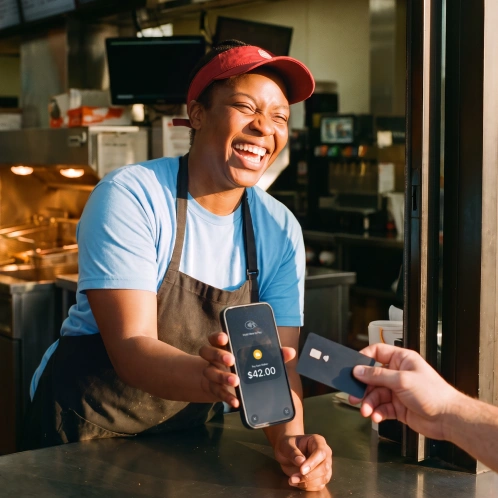
For retail businesses that need to accept payments on-site or on-the-go, JIM offers a streamlined solution. With JIM, you can accept debit, credit, and digital wallets directly through your smartphone. Just tap and done.
At just 1.99% per transaction with no hidden costs or extra hardware needed, it is particularly useful for market stalls or pop-up events. This simple rate structure makes it easier to predict your expenses.
- Get Started: Download the JIM app for iOS.
- Make a Sale: Type the sales amount, hit sell, and ask your customer to tap their card or device on your phone.
- Access Funds: Your money is available right on your JIM card as soon as the sale is done. There is no waiting for bank transfers.
Choose your payment system:
- Compare the total monthly cost, including transaction fees, for two payment processors.
- Decide which payment methods you plan to accept.
- Explore the JIM website to see if a phone-based system fits your business model.
How do you secure funding for a retail business?
Secure funding for a retail business through SBA-backed loans, microloans, or a business line of credit, and calculate six months of working capital before you apply. The SBA 7(a) loan program offers loans up to $5 million, with maximum interest rates set as the prime rate plus 3.0% to 6.5% depending on the loan amount.
With your business plan in hand, it's time to secure capital. The Small Business Administration (SBA) is a strong ally for retailers. Their 7(a) loan program offers loans up to $5 million. Maximum interest rates are tied to the prime rate plus a spread that ranges from 3.0% for loans over $350,000 to 6.5% for loans of $50,000 or less. You will likely need a credit score over 680 to qualify.
If you need less, consider an SBA Microloan, which caps at $50,000 and is available through community lenders. A business line of credit is another option, perfect for managing inventory purchases without dipping into your operating cash.
Calculate your working capital
Speaking of cash, many new owners focus on startup costs and overlook working capital. This is the money you need to operate for the first three to six months before sales ramp up. Your funding should cover this period completely.
Calculate your monthly rent, utilities, payroll, and marketing budget to find your target number. A cash shortfall in the early days is a tough hurdle, so building this buffer is a key move for stability.
From day one, manage your money with accounting software like QuickBooks Online or Xero. Also, open a separate business bank account as soon as your LLC is formed. It simplifies bookkeeping and protects your personal assets.
Line up your capital:
- Check your credit score to see where you stand.
- Use the SBA's Lender Match service to find local lenders.
- Calculate your operating expenses for the first six months.
- Open a dedicated business bank account for your LLC.
How do you hire and manage a retail team?
Hire and manage a retail team by starting with a part-time sales associate, using scheduling software to control labor costs, and tracking productivity with sales-per-employee benchmarks. A clear job description from day one prevents the common error of hiring too quickly.
Your first hire will likely be a part-time or full-time Retail Sales Associate. This role handles customer service, sales, and daily store upkeep. Expect to pay between $15 and $20 per hour, depending on your location and their experience.
Key roles and responsibilities
A sales associate is your front line. They should be personable and knowledgeable about your products. As you grow, you might add a Key Holder who can open and close the store. This role typically earns a dollar or two more per hour.
Hiring too quickly without clear expectations catches many owners off guard. You should draft a simple one-page job description that outlines daily tasks and performance goals. This document sets everyone up for success from the start.
With a team in place, you need to manage schedules. Software like Homebase or When I Work can simplify this. They help you create schedules, track hours, and communicate with staff, often with free plans for small teams.
As a general target, many small retailers aim for $150,000 to $250,000 in annual sales per full-time employee. This figure helps you gauge productivity and decide when it is time to hire more help.
Build your first team:
- Draft a job description for a Retail Sales Associate.
- Research hourly retail wages in your specific city.
- Compare the features of two scheduling software options like Homebase and When I Work.
- Calculate your estimated monthly payroll for one part-time employee.
How do you market a new retail store?
Market a new retail store by starting with local channels first, including a complete Google Business Profile and printed flyers, then plan a grand opening event to generate initial buzz. Your first customers will come from your neighborhood, not from national campaigns.
Your first customers will come from your neighborhood. Have 1,000 high-quality flyers printed for about $100 to $200 and distribute them locally. You can also partner with non-competing nearby businesses to cross-promote. Offer them a stack of your flyers in exchange for space for theirs.
A detail many new owners miss is the power of a Google Business Profile. It is free to set up and puts your store on Google Maps. Fill out every section with photos, hours, and your phone number. This is often the first impression a potential customer has of your business.
Plan your grand opening
A grand opening event creates initial buzz. Plan it for your first or second weekend. Offer a simple promotion, like 15% off all purchases or a free gift with a minimum spend. Promote the event on local Facebook groups and with your flyers a week in advance.
From day one, collect customer email addresses at the point of sale. This builds a direct marketing channel you own. A simple "Would you like to join our email list for future discounts?" is all it takes. Aim for an email capture rate of 10 to 20% from your initial customers.
Launch your local marketing:
- Set up and fully complete your Google Business Profile.
- Plan a grand opening event with a specific promotion.
- Get a quote to print 1,000 promotional flyers.
- Create a system to collect customer email addresses at checkout.
How do you set prices for retail products?
Set prices for retail products using keystone pricing as a baseline, then adjust based on competitor analysis and your full cost structure including shipping, rent, and labor. Forgetting to account for all costs is a common way a 50% margin shrinks to nothing.
A straightforward approach is keystone pricing, where you double the wholesale cost. If a product costs you $10, you sell it for $20. This method gives you a 50% gross margin, a common target for many small retail shops.
With that baseline, analyze your competitors. Check the prices for five of your core products at three rival stores. This helps you see if your keystone price is too high or low for your local market. You can adjust from there.
Explore different models
You are not limited to one strategy. For unique items, you might use a higher markup, perhaps 150% over wholesale. For common goods where you face more competition, you may need to price closer to your rivals to stay in the game.
A detail that trips up new owners is forgetting to account for all costs. Your price must cover the product, shipping, rent, and labor. A 50% margin can shrink fast if you overlook these other business expenses.
Set your price points:
- Calculate the keystone price for ten of your core products.
- Research the prices of those ten products at two local competitors.
- Decide on a primary pricing model for your store.
- List all your business costs to ensure your prices create real profit.
How do you control quality and scale a retail business?
Control quality and scale a retail business by tracking return rates and review scores, using sales-per-employee benchmarks to time new hires, and waiting for 12 to 18 months of profitability before opening a second location. Premature expansion is a frequent cause of retail failure.
To maintain quality, track your product return rate and online reviews. A return rate below 5% is a healthy target for most small shops. Also, aim for an average customer review score of 4.5 stars or higher on your Google Business Profile.
When to expand your operations
Use clear benchmarks to guide your growth. Once your annual sales per full-time employee exceed $250,000, it is time to hire more help. This ensures you can maintain customer service standards without burning out your team.
It can be tempting to open a second store after a few strong months. A more stable approach is to wait for 12 to 18 consecutive months of solid profitability. This confirms your business model is sound before you take on more risk.
As you grow, your initial systems may need an upgrade. Look at platforms like Lightspeed Retail or Shopify POS. They offer advanced inventory management and multi-store capabilities that a basic system cannot handle.
Track and prepare to scale:
- Track your product return rate for one month.
- Calculate your current sales per employee.
- Set a target for your Google Business Profile review score.
- Review the multi-store features of a system like Lightspeed Retail.
You now have a clear roadmap to launch your retail store. Remember that your connection to the local community is your greatest asset. Focus on the details and customer experience, and you will build a business that lasts. You are ready to begin.
And when you make that first sale, a simple payment solution helps. JIM lets you accept cards directly on your smartphone for a flat 1.99% fee, with no extra hardware. It keeps your costs predictable from day one. Download JIM to get started.
Frequently Asked Questions
How much does it cost to open a small retail store?
Do you need an LLC to start a retail business?
What licenses and permits does a retail store need?
How do retail payment processing fees work?
When should a retail store hire its first employee?



Sell and get paid in seconds with Jim