How to Start a Sneaker Reselling Business
See article summary
- Sneaker reselling is a multi-billion dollar secondary market where limited releases trade above retail the moment they sell out.
- Startup cost runs $1,800 to $3,600: inventory, shipping supplies, and LLC filing fees.
- Form an LLC, get a free EIN from the IRS, and secure a seller's permit to collect sales tax.
- Source at retail through raffles and in-store drops, then authenticate every pair before listing.
- Price from live StockX and GOAT data and aim for a 30 to 50% net profit margin after fees.
Sneaker reselling is a multi-billion dollar secondary market where limited releases trade at premiums the moment they sell out at retail. For a reseller with $1,500 in starting capital, that is enough to acquire 5 to 10 pairs of in-demand sneakers and start flipping.
Below is the full sequence: validate the market, source and authenticate inventory, set up a legal structure, insure your stock, equip a workspace, accept payments, fund the business, hire help, market listings, price for profit, and scale. Every section gives the exact costs, tools, and actions you need to launch a sneaker reselling business in the U.S.
How much does it cost to start a sneaker reselling business?
Startup cost runs $1,800 to $3,600 total: $1,500 to $3,000 for 5 to 10 pairs of inventory, roughly $100 in shipping supplies, and $50 to $500 in state LLC filing fees. Validate demand before you spend more than half of that budget on a single model.
Market and competitor research
Immerse yourself in the sneaker world before you spend. Follow platforms like Hypebeast and Sneaker News daily, and use Google Trends to check search interest for the specific models you plan to target. Rising search interest often precedes a price spike on the secondary market.
Use marketplaces like StockX and GOAT as your research databases. Look up the sales history for sneakers similar to what you want to sell. Note the price changes, sales volume, and average resale value over the last 90 days. A model with steady volume and a stable spread between retail and resale is safer than a hyped release with volatile swings. The same demand-validation approach applies to a clothing resale business, where sold-comps set your price ceiling.
Budgeting your startup costs
Your initial inventory is the largest expense. A budget of $1,500 to $3,000 lets you acquire 5 to 10 pairs of in-demand sneakers. The common misstep is buying too much inventory in one model without first testing the market, which locks up cash in slow-moving stock.
Beyond inventory, account for setup costs. State LLC filing fees range from about $40 to $500 depending on your state. Shipping supplies run about $100. Marketplace fees on platforms like GOAT or eBay take 9 to 15% of your final sale price, so build that into every price calculation.
Here are 3 immediate steps to take:
- Track 5 to 10 upcoming sneaker releases on platforms like Hypebeast or Sneaker News.
- Analyze the 90-day resale price history for 3 comparable models on StockX.
- Create a startup budget that includes inventory, potential legal fees, and shipping supplies.
Where do you source and authenticate sneakers to resell?
Sneaker reselling lives or dies on sourcing and authentication. You need reliable channels to acquire inventory at or below retail, and a repeatable process to verify every pair is genuine before you list it.
Sourcing channels
Retail is the primary source for new inventory. Enter raffles on the SNKRS app and retailer sites for limited releases, and line up in-store for drops that do not sell out online. Retail arbitrage, buying at retail and reselling at market price, is the lowest-risk entry point because your cost is fixed.
Consignment and wholesale are higher-volume but riskier. Consignment stores let you sell on their platform for a 15 to 25% commission without holding inventory. Wholesale requires a resale certificate and a relationship with an authorized distributor, and many brands restrict distribution of limited releases. Retail bots, automated software that buys drops faster than a human can, violate the terms of service of most retailers and can get your accounts banned, so avoid them.
Authentication and counterfeit prevention
Counterfeits are the biggest financial risk in reselling. Selling a fake pair, even unknowingly, destroys your reputation and can lead to chargebacks and platform bans. Authenticate every pair before you list it.
Use a verification service for high-value pairs. StockX and GOAT authenticate items sold through their platforms, and independent services like Legit Check and CheckCheck offer per-item authentication for a fee when you buy outside a marketplace. For every pair, inspect the stitching, the box label, the size tag, the glue lines, and the smell of the materials against a known authentic pair. Document the condition with photos before listing so you have proof if a buyer disputes authenticity.
How do you set up a legal structure and get licensed?
Form a Limited Liability Company (LLC) to separate your personal assets from your business debts, then get a free Employer Identification Number (EIN) from the IRS and a seller's permit from your state. The LLC protects personal assets like your car or home from business liabilities.
For federal tax purposes, the IRS classifies an LLC by its ownership. A single-member LLC is treated as a disregarded entity, taxed as a sole proprietorship where profits and losses pass through to your personal return. A multi-member LLC is taxed as a partnership by default. Source: IRS LLC filing as a corporation or partnership.
To form an LLC, file Articles of Organization with your state's Secretary of State. Filing fees vary by state, from roughly $40 to $500. The SBA maintains a state registration lookup that links to each state's Secretary of State portal. After forming the LLC, apply for a free Employer Identification Number (EIN) on the IRS website. You need an EIN to open a business bank account.
Permits and licenses you will need
Do not confuse a seller's permit with a resale certificate. They are distinct instruments. A seller's permit, issued by your state, authorizes you to sell taxable goods and requires you to collect sales tax from customers. A resale certificate is a document you present to suppliers so you can buy inventory tax-free for resale. Many states require both. Apply for the seller's permit through your state's Department of Revenue. The SBA outlines the licenses and permits most states expect, including sales tax registration.
You will also likely need a general business license from your city or county. Check their official website for the specific requirements and fees, which typically range from $50 to $150 annually.
Here are 3 immediate steps to take:
- File Articles of Organization for an LLC with your Secretary of State to protect your personal assets.
- Apply for a free Employer Identification Number (EIN) on the IRS website.
- Register for a seller's permit with your state's Department of Revenue.
How do you insure a sneaker reselling business?
Buy Business Property Insurance first. It protects your inventory from theft, fire, or water damage, which is the single most important policy for an online reseller. Do not rely on a homeowner's or renter's policy: standard HO-3 forms cap business property at about $2,500 on the premises and $250 off the premises, far below the resale value of a sneaker inventory. Source: Insurance Information Institute, Insuring Your Home Business.
Key insurance policies for resellers
Aim for a policy that covers the full resale value of your inventory, which starts at $10,000 to $20,000 for a typical starter stock. Premiums vary by coverage amount, location, and deductible, so request quotes from at least two providers rather than relying on a published average.
General Liability Insurance becomes relevant if you do in-person meetups or have a physical location. It covers claims of customer injury or property damage. Look at providers like Hiscox, The Hartford, or Next Insurance that cater to small online businesses.
Here are 3 immediate steps to take:
- Calculate the total resale value of your sneaker inventory.
- Review your homeowner's or renter's policy to confirm its business property coverage limit.
- Get quotes for Business Property Insurance from at least two providers like Hiscox or The Hartford.
How do you set up a workspace and equipment for reselling?
Start at home with a 50 to 100 square foot storage area, a lightbox for photos, a shipping scale, and a thermal label printer. Total equipment budget runs $380 to $480, and you do not need a commercial storefront.
Your workspace setup
Most resellers begin at home. Designate a clean, dry space of at least 50 to 100 square feet, like a spare room or a large closet, to store your inventory safely. Check your local city's rules on "home occupation" to ensure you comply.
Photography and shipping gear
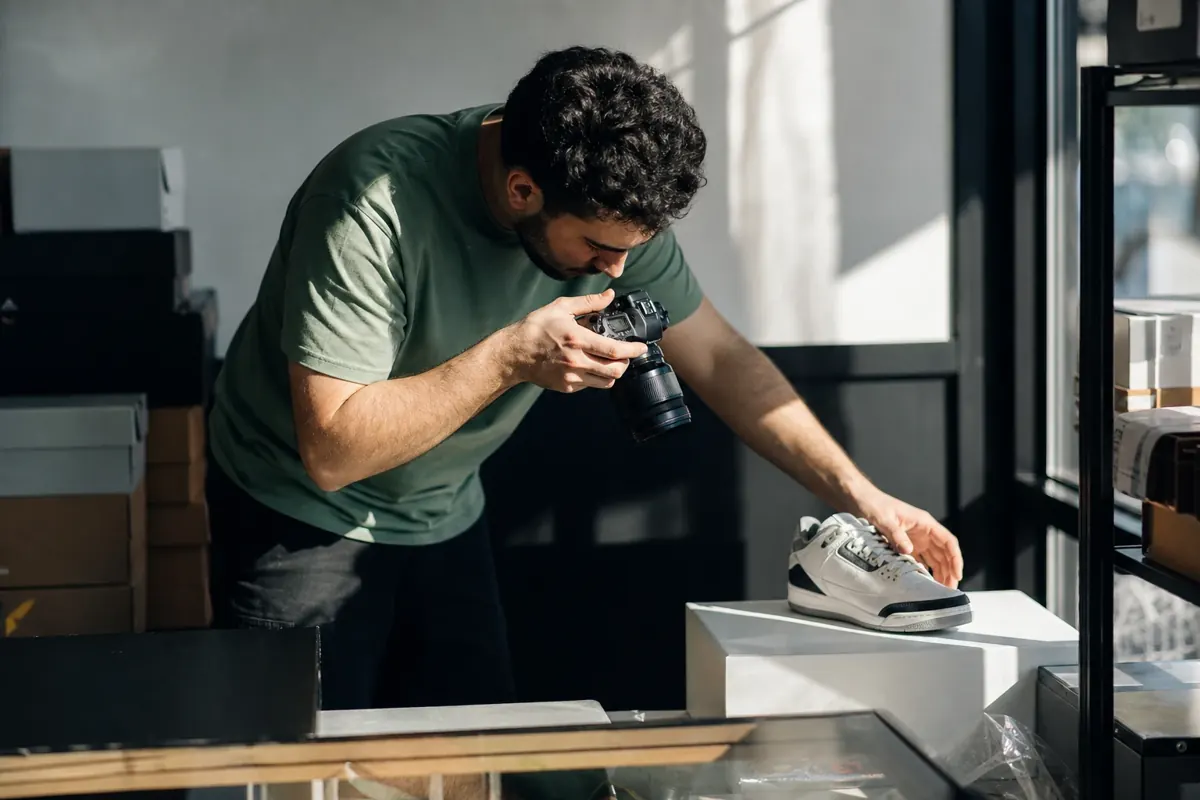
Clear photos sell sneakers. A simple lightbox for photography costs between $50 and $150. You will also need a shipping scale, which runs about $30, and sturdy shelving like an IKEA Kallax unit for around $100 to keep your boxes organized and off the floor.
Many new sellers try to save money by printing shipping labels on paper. This is slow and looks unprofessional. Buy a thermal label printer like a Rollo or Dymo for about $200. It is a smart upfront investment that saves significant time on every shipment.
For shipping supplies, look at providers like Uline or The Boxery. Buying boxes in bulk quantities of 50 or 100 dramatically lowers your per-shipment cost. A standard 14x10x6 inch box is a good starting size for most sneaker boxes.
Here are 3 immediate steps to take:
- Measure and clear a 50 to 100 square foot area in your home for inventory.
- Create a budget for your initial equipment, including a lightbox and thermal printer.
- Compare bulk pricing for 50 shipping boxes from a supplier like Uline.
How do you set up payment processing for sneaker sales?
Use the marketplace's built-in payment system for online sales, and a tap-to-pay app for in-person sales at sneaker conventions and local meetups. Watch the processing fees, since many processors charge 2.5% to 3.5% per transaction.
For resellers who need to accept payments on-site or on-the-go, JIM offers a streamlined solution. With JIM, you can accept debit, credit, and digital wallets directly through your smartphone. At just 1.99% per transaction with no hidden costs or extra hardware, it is great for in-person sales.
- Get Started: Download the JIM app for iOS.
- Make a Sale: Type the sales amount, hit sell, and ask your customer to tap their card or device on your phone.
- Access Funds: Your money is available right on your JIM card as soon as the sale is done.
Here are 3 immediate steps to take:
- Review the payment processing fees for any marketplaces you plan to use.
- Calculate the fee on a hypothetical $250 sneaker sale using JIM's 1.99% rate.
- Download the JIM app to familiarize yourself with its interface for future in-person sales.
How do you fund a sneaker reselling business?
Most resellers start with personal savings, then graduate to a 0% introductory APR business credit card or an SBA Microloan once they have a sales track record. The right choice depends on your credit and how fast your inventory turns over.
Securing your startup capital
Use personal savings for your first inventory purchase. A 0% introductory Annual Percentage Rate, or APR, the yearly cost of borrowing money, on a business credit card can fund inventory, but the common misstep is letting interest accumulate on shoes that do not sell quickly, which wipes out your profit margins when the promotional period ends.
For a larger inventory purchase, the SBA Microloan program offers loans up to $50,000 through nonprofit intermediary lenders, with interest rates generally between 8% and 13% and a maximum repayment term of seven years. The average microloan is about $13,000. SBA-approved lenders make all credit decisions and set the terms, so contact an intermediary in your area to learn the credit score and business plan requirements.
Managing your cash flow
Plan to have about $5,000 to $10,000 in working capital for your first six months. This amount covers new inventory, shipping supplies, and marketplace fees while you await payouts from sales. It ensures you can keep your business running smoothly.
From day one, open a separate business bank account. This makes tax season much easier and gives you a clear view of your profitability. You can also use software like QuickBooks Self-Employed to track every expense and sale right from the start.
Track taxes and Form 1099-K
Every marketplace sale is taxable income, whether or not you receive a tax form. Payment apps and online marketplaces must send you a Form 1099-K when your gross payments for goods or services exceed $20,000 across more than 200 transactions in a year. Some states and platforms use a lower threshold, so you may receive one below the federal limit. Regardless of the threshold, you must report all reselling income on your tax return.
Report reselling income and expenses on Schedule C, the self-employment profit or loss form, as long as you operate with a profit motive. The IRS distinguishes a business from a hobby on whether you run it to make a profit. Source: IRS, Know the difference between a hobby and a business. Track your cost basis, the original purchase price of each pair, because the 1099-K reports gross sales without subtracting what you paid for the inventory. Keeping those records lets you report net profit accurately and avoid overpaying tax.
Here are 3 immediate steps to take:
- Open a dedicated business bank account to keep your finances separate.
- Research SBA Microloan lenders in your state if you need external funding.
- Set up a bookkeeping system with software like QuickBooks Self-Employed.
When do you hire help and streamline operations?
Run the business alone until you consistently ship more than 10 to 15 pairs a day or your monthly revenue tops $10,000. Your first hire is a part-time Inventory and Shipping Assistant at $15 to $20 per hour, brought on only when order fulfillment consumes more than 3 to 4 hours of your day.
When to make your first hire
You will likely be a one-person show at the start. Handle every task yourself, from sourcing to shipping. This gives you a deep understanding of your business before you bring anyone else on board.
Once you consistently ship more than 10 to 15 pairs a day, or your monthly revenue surpasses $10,000, hire a part-time Inventory and Shipping Assistant. Many new resellers hire too soon, which can drain cash flow. Wait until order fulfillment consumes more than 3 to 4 hours of your day.
Your first hire should be a part-time Inventory and Shipping Assistant. Their duties would include inspecting sneakers, taking photos, packing orders, and managing stock. Expect to pay an hourly rate of $15 to $20 for this role. No special certifications are needed.
Systems to manage your operations
At first, a simple Google Sheet is enough to track your inventory and sales. Create columns for the sneaker model, size, purchase cost, sale price, and date sold. This gives you a clear view of your profit per pair.
Once your inventory grows beyond 50 pairs, manual tracking becomes risky. Switch to an inventory management app like Sortly, which lets you create visual entries with photos to prevent mix-ups and lost stock.
Here are 3 immediate steps to take:
- Track your daily order volume for 30 days to establish a baseline.
- Create a basic inventory tracking spreadsheet with Google Sheets.
- Draft a simple job description for a part-time Inventory and Shipping Assistant.
How do you market your sneaker reselling business?
Build an audience on Instagram and TikTok with unboxing and on-foot content, and optimize your marketplace listings with at least 10 high-resolution photos and fast shipping. Your reputation score directly drives how much you can charge.
Build your brand on social media
Instagram and TikTok are your primary marketing channels. Post high-quality photos and short-form videos, like unboxings or on-foot looks. Use specific hashtags such as #Jordan1, #yeezy, and #sneakerreseller to reach your target audience.
Posting photos is not enough. Engage with your audience. Respond to every comment and DM. Run polls about upcoming drops or ask questions to boost interaction. An engagement rate of 3 to 5% is a healthy target for your posts.
Optimize your marketplace listings
Your reputation on platforms like eBay and Grailed directly impacts sales. A feedback score above 99% can often justify a 5 to 10% higher price. Ship within 24 hours and communicate clearly with buyers to build that trust from the start.
Many sellers upload just a few quick photos. Instead, provide at least 10 high-resolution images for each listing. Show all angles, the box, the size tag, and any potential flaws. This transparency reduces buyer questions and can speed up sales.
Here are 3 immediate steps to take:
- Create an Instagram business account and post your first unboxing video.
- Research and list 10 relevant hashtags for a sneaker you plan to sell.
- Review a competitor's eBay listing and identify three ways to improve your own.
How do you price sneakers for resale?
Set prices from the live market data on StockX and GOAT for the exact model, size, and condition, then aim for a net profit margin of 30 to 50% after platform fees and shipping. Always price the specific size you are listing, not the model average.
Pricing models and research
Your pricing will be almost entirely market-driven. Use platforms like StockX and GOAT as live databases. Look up the exact sneaker, size, and condition to see its current market value and 90-day sales history. This data tells you what buyers are actually willing to pay right now.
Aim for a net profit margin of 30 to 50% after all expenses. Worked example: you buy a deadstock Air Jordan 4 Bred Reimagined at its $215 retail price and sell it on StockX at the market price of $385 twelve days later. StockX takes a 10% transaction fee of $38.50 and a $6 processing fee, and shipping runs about $15. Your net profit is $385 minus $215, minus $38.50, minus $6, minus $15, which is $110.50. That is about a 51% net margin on your cost basis, achieved in under two weeks.
A frequent mistake is only looking at the sale price and forgetting the deductions. Those platform fees, shipping costs, and even the cost of your shipping box will reduce your final take-home pay. Always calculate your net profit, not just the gross spread.
Price varies by size and condition. A deadstock pair in a popular size like 10 or 11 might sell for 10 to 20% more than the same shoe in a less common size. Always check the specific "last sale" data for the exact size you are listing.
Here are 3 immediate steps to take:
- Research the 90-day price history of a target sneaker on StockX in your size.
- Calculate the net profit on a hypothetical $350 sale, subtracting a 10% marketplace fee and a $15 shipping cost.
- Compare the price of a deadstock sneaker to a used one on GOAT to see the condition premium.
How do you maintain quality and scale your operations?
Define quality standards from day one, track a feedback score above 99% and a return rate below 2%, and scale in three tiers as inventory and revenue grow. Never rent a warehouse before your software needs it.
Upholding your quality standards
Define your quality standards from day one. For "deadstock" pairs, this means they are unworn with the original box and all accessories. For used pairs, create a simple 1 to 10 rating scale and use it consistently in your descriptions to build buyer trust. A shoe cleaning business can also be a natural add-on service that raises the value of used inventory before you list it.
Your metrics will tell the story. Aim for a customer feedback score above 99% and a return rate below 2%. These numbers are your best indicators of product quality and description accuracy. Track them weekly to catch any issues early.
Scaling your operation
Most resellers move through three tiers as they grow. Use this framework to recognize when to upgrade, and avoid spending ahead of your revenue.
- Tier 1, Starter: Under 50 pairs, under $5,000 monthly revenue. Track inventory in a Google Sheet, sell on marketplaces, and keep overhead near zero.
- Tier 2, Established: 50 to 100 pairs, $5,000 to $15,000 monthly revenue. Move to an inventory app like Sortly, and hire a part-time shipping assistant once order fulfillment exceeds 3 to 4 hours a day.
- Tier 3, Scaled: Over 100 pairs, over $15,000 monthly revenue. Launch your own Shopify store to build a brand and increase margins, and only then rent a small warehouse.
Many resellers get excited and rent a small warehouse too early, which drains cash. A better first step at Tier 3 is to upgrade your software. An app like Sortly manages a large inventory, and Shopify gives you a dedicated sales channel without the high overhead. For a broader walkthrough of choosing a business structure and forming an LLC, the same fundamentals apply as you formalize and scale.
Your first sale is the goal that matters most. List your first pair within a week of reading this guide, track the profit on that pair to the dollar, and reinvest it into inventory. Every metric in this guide, from feedback score to net margin, improves with repetition.
For those in-person sales, a simple payment process helps. JIM lets you accept cards right on your smartphone for a flat 1.99% fee, no extra hardware needed. This makes getting paid easy, so you can focus on your next move. Download JIM and be ready for your first customer.
Frequently Asked Questions
Is sneaker reselling legal?
How much money do I need to start reselling sneakers?
Do I have to pay taxes on sneaker reselling?
Which platforms are best for reselling sneakers?
What profit margin should I aim for?




Sell and get paid in seconds with Jim