How to start a utility locating company from the ground up
See article summary
- A solo utility locating startup runs $40,000 to $80,000, dominated by an EM locator and a work truck.
- File an LLC, get a free IRS EIN, and check your state's contractor board for locator certification rules.
- Carry general liability plus errors and omissions insurance, since one line strike can exceed a low coverage limit.
- Price at a 50 to 60 percent gross margin across hourly, flat fee, and per linear foot models.
- Track your damage rate against CGA DIRT Report benchmarks and expand when revenue nears $120,000.
Launching a utility locating company takes roughly $40,000 to $80,000 in startup capital, a state locator certification, and four to eight weeks of licensing lead time. A utility locator is a technician or company that finds and marks underground utilities like gas, water, and telecom lines before excavation, so crews do not strike them. Demand holds steady because every construction project, road repair, and pipeline installation starts with a locate, and the Common Ground Alliance Damage Information Reporting Tool (DIRT) Report records hundreds of thousands of damage events each year when locates are skipped or wrong.
This guide walks through validating demand, buying equipment, getting licensed and insured, funding the business, hiring, and pricing, so you can launch a utility locating company in the U.S. with accurate numbers and primary sources.
How do you validate demand for a utility locating business?
Demand validation starts with local construction activity and the 811 one-call system, the free national service anyone must contact before digging so utilities can mark their own lines. Check public construction permit records at your city or county planning office, and call construction companies, engineering firms, and municipal public works departments in your target area to ask about their current locating providers and satisfaction levels. Review the 811 Before You Dig directory for your state to see which private locating companies already operate there, since the 811 system itself handles utility-owner locates while private locators fill the gap for excavators who need faster or more detailed marks.
Competition research starts with a Google Maps search for "utility locators near me." For a deeper look, check your state's 811 directory for registered companies and scan business databases like Dun and Bradstreet for revenue estimates. A crowded field is not a dealbreaker, because demand scales with construction volume and most private locators are booked weeks out during peak season.
How much does it cost to start a utility locating company?
Plan to spend between $40,000 and $80,000 to launch, with equipment and a vehicle taking the largest share. A frequent misstep is underestimating equipment costs, because quality gear drives accuracy and accuracy drives your liability exposure.
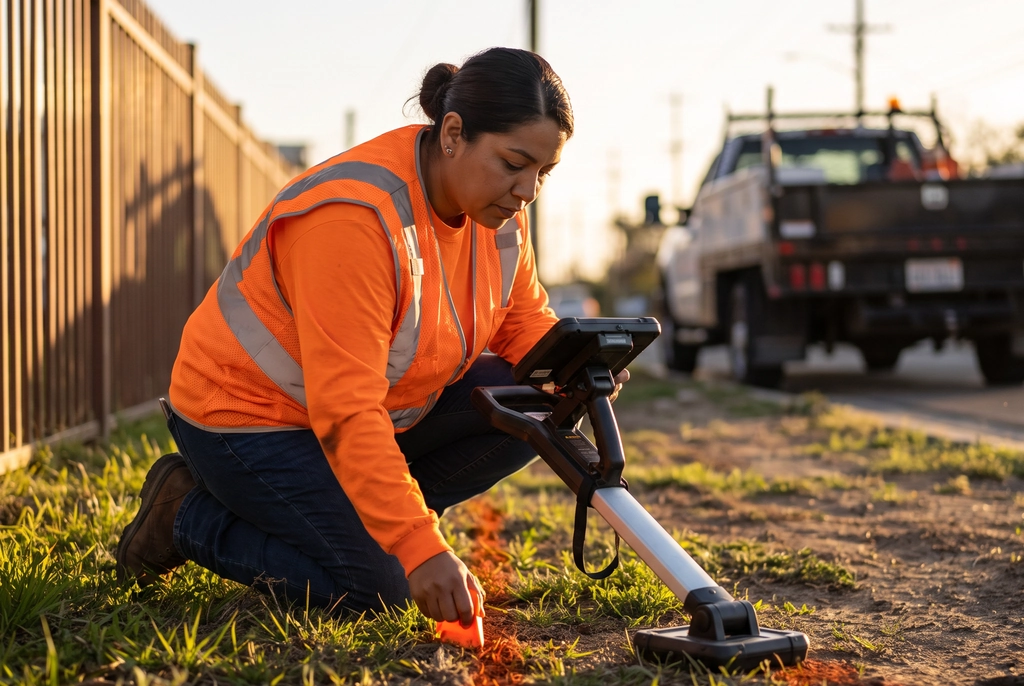
An electromagnetic locator, the primary device for tracing conductive utilities, runs $3,000 to $10,000. Ground Penetrating Radar (GPR), which detects non-conductive utilities like plastic pipe, costs $15,000 to $25,000 and works as a later addition as revenue grows. Brands like Radiodetection and Vivax-Metrotech dominate the field. A reliable work truck adds $20,000 to $40,000, insurance runs $2,000 to $5,000 annually, and business registration adds $500 to $1,500.
Here is a breakdown of typical startup costs:
| Item | Typical cost | Notes |
|---|---|---|
| Electromagnetic (EM) locator | $3,000 to $10,000 | Primary device; Radiodetection, Vivax-Metrotech |
| Ground Penetrating Radar (GPR) | $15,000 to $25,000 | Add later for non-conductive utilities |
| Work truck | $20,000 to $40,000 | Reliable vehicle for job site access |
| Insurance (general liability + E&O) | $2,000 to $5,000 per year | Annual premium, not startup total |
| Business registration | $500 to $1,500 | LLC filing and permits |
| Marking supplies and rugged tablet | $500 | Paint, flags, digital mapping |
Your immediate action list:
- Contact three local construction firms to ask about their current utility locating providers.
- Use your state's 811 directory to list five potential competitors in your service area.
- Build a startup budget spreadsheet using the cost ranges above.
How do you set up your legal structure and get licensed?
A Limited Liability Company (LLC) is the standard structure because it separates your personal assets from business debts, protection a sole proprietorship does not offer. File for an LLC with your Secretary of State for about $100 to $500. Once filed, get an Employer Identification Number (EIN) from the IRS at no cost. You need this number to open a business bank account, and it functions like a Social Security number for your company.
What licenses and permits does a utility locator need?
Licensing requirements vary by state, so check with your state's contractor licensing board or public utility commission for locator certification rules. Some states require a specialty contractor license for utility locating, while others regulate it through the 811 system. Operating without the right state credentials can lead to heavy fines. You must also register with your state's 811 system to receive dig requests, and secure a general business license from your city or county clerk.
State certifications, where required, can cost $300 to $1,000 and take four to eight weeks to process. Because these requirements vary by jurisdiction, verify the exact fee and timeline with your state board. Georgia, for example, licenses utility contractors through the Georgia Secretary of State, while other states route locator credentials through their contractor boards.
Your immediate action list:
- File LLC paperwork with your Secretary of State.
- Apply for a free EIN on the IRS website.
- Research your state's locator certification requirements through its contractor board.
- Contact your local city or county clerk to apply for a business license.
How do you secure insurance and manage risk?
Insurance is your primary defense against job site risk, not a formality. A single inaccurate locate can cause a gas line strike or a fiber cut that shuts down a neighborhood, making solid coverage a business survival requirement.
What insurance policies does a utility locator need?
You need several coverage types. General liability insurance, with a $1 million to $2 million limit, covers third-party property damage and typically costs $1,000 to $3,000 annually. Professional liability, also called Errors and Omissions (E&O), covers mistakes in your locating work. A $1 million E&O policy runs $1,500 to $4,000 per year. Many new owners underinsure their E&O policy to save money, but one line strike claim can easily exceed a low coverage limit.
Add commercial auto insurance for your work truck, since personal auto policies do not cover business use. Inland marine coverage protects your expensive GPR and EM locators from theft or damage in transit. Work with an insurance broker who specializes in construction trades, because they understand the specific risks of locating work. Providers like The Hartford, Hiscox, and CoverWallet have experience with contractors and can assemble an appropriate package.
Your immediate action list:
- Request quotes for a $1 million professional liability (E&O) policy.
- Ask about bundling general liability and commercial auto insurance for a discount.
- Contact an insurance agent who specializes in construction or trade businesses.
- Ensure your GPR and EM locator are listed on an inland marine policy.
How do you set up your location and buy equipment?
Where should you base your operations?
A home office combined with a secure garage or storage unit for your truck and equipment works at first. Check your local zoning ordinances for rules on parking a commercial vehicle at a residence. If you prefer a separate office, a short-term lease of around 200 to 300 square feet keeps overhead low while you build your client base. Negotiate a one-year lease instead of a longer term so you stay flexible.
What equipment do you need to buy?
Your accuracy depends on your equipment. An electromagnetic locator is your primary device, costing $3,000 to $10,000. Ground Penetrating Radar, running $15,000 to $25,000, is a later addition as your business grows. Many new owners try to save money with used gear. Equipment without a recent calibration certificate or warranty can produce bad locates, which puts you at risk for liability claims. Always buy from reputable dealers like Radiodetection or Vivax-Metrotech.
You will also need marking supplies. Budget about $500 for utility marking paint, flags, and a rugged tablet for digital mapping. Suppliers like Berntsen or local survey equipment shops provide these items without large minimum orders.
Your immediate action list:
- Review your city's zoning laws for home-based businesses with a work vehicle.
- Get quotes for a new EM locator from two different suppliers.
- Create a budget for adding a GPR system within your first year.
- Source a local supplier for marking paint and flags.
How do you set up your payment systems?
What payment terms should you offer?
Most construction and municipal clients work on Net 30 terms, meaning payment is due 30 days after you invoice. For these larger contracts, checks and ACH bank transfers are the standard payment methods. Many new owners run into cash flow issues because they fail to formalize these terms. Always include your payment policy in your service agreement to set clear expectations from the start.
How do you accept on-site payments?
For smaller residential jobs or one-off locates, you need a way to accept payment immediately. A mobile payment solution lets you close out the job and get paid on the spot, which improves cash flow. A flat-rate processor that turns your smartphone into a card reader without extra hardware fits this use case well. JIM charges 1.99% per Tap to Pay transaction with no hidden costs or extra hardware, which undercuts the 2.5% to 3.5% plus hardware fees many processors charge. That matters for a deposit on a large project or a quick residential settle.
Your immediate action list:
- Draft your standard payment terms (for example, Net 30) to include in all client agreements.
- Ask your business bank about its process and fees to receive ACH transfers.
- Compare flat-rate mobile processors for on-the-go payments.
- Calculate the potential savings on a $500 transaction at 1.99% versus a typical 2.9% rate.
How do you secure funding and manage your finances?
For big-ticket items like locators and a truck, equipment financing is often the most direct route. Lenders like Currency or Crest Capital specialize in construction gear, and these loans use the equipment as collateral, which simplifies the approval process.
For broader business costs, an SBA 7(a) loan can cover working capital and other expenses. The maximum loan amount is $5 million, and rates are negotiated between borrower and lender but capped by SBA maximums pegged to the prime rate. The SBA maximum rate ranges from base rate plus 3.0% on loans over $350,000 to base rate plus 6.5% on loans of $50,000 or less. You need a strong business plan and good personal credit to qualify.
How much working capital do you need?
Many new owners focus only on equipment costs and run out of cash quickly. You need a buffer to cover operating expenses for the first six months while you wait for client payments. This is your working capital, the cash reserve that keeps the business running before receivables come in. This fund should cover your insurance, fuel, marketing, and a modest salary. For a solo operator, that often means having $15,000 to $30,000 in the bank. Grants are rare in this field, but you can check with your local Small Business Development Center (SBDC) for regional programs. Managing that buffer well, including how you accept payments on Net 30 contracts, is the same cash flow challenge other field service businesses face when they start a water well drilling company.
Your immediate action list:
- Request a quote for equipment financing from a specialized lender.
- Contact your bank to discuss the SBA 7(a) loan application process.
- Create a spreadsheet to calculate six months of your operating expenses.
- Schedule a free consultation with your local Small Business Development Center.
How do you hire your team and set up operations?
How do you build your locating team?
Your first hire will likely be a Utility Locator Technician, the person who handles fieldwork from using the EM locator to documenting findings. Expect to offer a salary between $45,000 and $65,000, depending on experience and certifications. A frequent mistake is hiring someone with general construction experience but no formal locator training. Look for candidates with a NULCA (National Utility Locating Contractors Association) certification or training from a program like Staking University. NULCA publishes the Professional Competence Standard for locating technicians, the industry benchmark for fieldwork quality, and candidates trained to that standard are your best defense against inaccurate locates.
How do you streamline daily operations?
Once you have a technician, you need to manage job schedules. Field service management software like Jobber or KorTerra organizes your dispatch, client communication, and invoicing, which prevents missed appointments and double bookings as you grow.
Set revenue goals based on a simple target: each field technician should generate roughly two to three times their annual salary in revenue. This is a rule of thumb drawn from field service economics, not a published industry standard, so use it as a starting benchmark and adjust based on your actual utilization and pricing.
Your immediate action list:
- Draft a job description for a Utility Locator Technician that lists NULCA certification as a requirement.
- Research the curriculum for a locator training program like Staking University.
- Sign up for a free trial of a field service software to test its scheduling features.
- Calculate a target revenue goal for your first hire based on their projected salary.
How do you market your services and find clients?
How do you establish your digital footprint?
Create a simple one-page website using a platform like Squarespace that clearly lists your services, service area, and contact information. Set up a Google Business Profile, because that is how most local clients discover you. After your first few jobs, ask for reviews to build credibility quickly, since positive reviews are a powerful signal to potential customers.
How do you connect directly with contractors?
Direct outreach is your most powerful strategy. Review public records for new construction permits and identify five general contractors to contact. A brief phone call to introduce your services can open doors. Many new owners wait for work to come to them instead. Proactively attend local builder association meetings, because a single relationship built at one of these events can provide a steady stream of projects.
Expect a customer acquisition cost (CAC) of around $200 to $400 for each new long-term client once you factor in your time and marketing spend. Treat this as a planning estimate rather than a hard industry figure, since your actual CAC depends on your local market and outreach efficiency.
Your immediate action list:
- Build a one-page website that details your services and contact info.
- Create and verify your Google Business Profile.
- Identify five local contractors from public permit records to contact this week.
- Find the date of the next local builder association meeting and plan to attend.
How do you price your services for profit?
What pricing structure should you use?
Most locators use a mix of pricing models. Hourly rates of $100 to $200 work well for complex jobs with an unknown scope. For standard residential work, a flat fee between $250 and $500 is more common and easier for clients to understand. On larger commercial sites, you can price per linear foot, typically $0.50 to $2.00. Many new owners price too low to win bids, which is not sustainable. Always factor your overhead costs into every quote.
What profit margin should you target?
Aim for a gross profit margin of 50 to 60%, the percentage of revenue left after direct job costs like labor, fuel, and supplies. If a job costs you $400 in labor, fuel, and supplies, bill between $800 and $1,000. Establish a minimum service fee, perhaps $150, to cover your call-out cost for any job. To check your numbers against the market, call a few local competitors, pose as a potential customer, and ask for a quote on a simple project. This gives you direct insight into what others charge and helps you position your rates without devaluing your service.
Your immediate action list:
- Call three local competitors to get a quote for a standard residential locate.
- Calculate your hourly break-even rate, which includes all overhead costs.
- Create a simple price sheet with rates for hourly, flat-fee, and per-foot services.
- Establish a minimum service fee for all call-outs.
How do you implement quality control and scale?
How do you establish quality standards?
Your reputation depends on accuracy. Adopt the NULCA Competence Standard as your internal benchmark for all fieldwork. Create a simple post-job audit process and review 10% of your locate documentation each week to catch inconsistencies before they become problems. Many new owners neglect a formal quality check, which leads to inconsistent marks and incomplete records. A simple checklist for technicians to complete after each job confirms all utilities were marked and photos were taken.
How do you track performance and plan for growth?
Measure your damage rate, the number of line strikes per 1,000 locate tickets. The CGA DIRT Report tracks this metric nationally and shows it fluctuating year to year in the range of roughly 1.3 to 2.0 damages per 1,000 one-call transmissions, so use that range as your baseline for field accuracy and liability risk. Once you consistently hit your revenue targets and have to turn down work, it is time to expand. A practical signal to hire another technician is when your annual revenue approaches $120,000. At that point, software like KorTerra helps manage the added job volume and technician schedules.
For excavators who need engineering-grade utility data beyond a standard mark, Subsurface Utility Engineering (SUE), defined under the ASCE 38-22 standard, is a related but distinct discipline that uses vacuum excavation and surveying to map utility quality levels. A private utility locator fills the gap between the free 811 utility-owner marks and full SUE engineering, which is where most independent locating companies operate.
Your immediate action list:
- Download the NULCA Competence Standard to use as your quality guide.
- Create a post-job checklist for technicians to ensure complete documentation.
- Set up a spreadsheet to track your damage rate per 1,000 locate tickets.
- Calculate the revenue threshold for hiring your next technician based on a $120,000 target.
Conclusion
Your reputation for accuracy is your most valuable asset in utility locating. Each precise mark builds trust and secures future work. Keep your damage rate below the CGA DIRT baseline, hold a 50 to 60% gross margin, and expand your team only when revenue approaches $120,000. When you handle payments on smaller jobs, JIM turns your smartphone into a card reader at a flat 1.99% fee with no extra hardware, so you can Download JIM to simplify your cash flow from the start.
Frequently Asked Questions
Is utility locating profitable?
Do you need a license to locate utilities?
What is the difference between 811 locating and a private utility locator?
How much does a utility locator make?
What equipment do I need to start a utility locating business?




Sell and get paid in seconds with Jim