How to start an auto glass repair business: your roadmap
See article summary
- Startup costs run $17,000 to $42,000 for a van, tools, inventory, licenses, and insurance.
- Plan 6 to 12 weeks from LLC registration to your first paid job.
- Required documents: LLC formation, EIN, Business License, Seller's Permit, and AGSC certification.
- A solo technician can generate $150,000 to $200,000 in annual sales at full capacity.
- Keep your comeback rate under 2% and maintain AGSC certification to protect quality.
A one-van auto glass operation breaks even around job 85, based on a $17,000 to $42,000 startup outlay. That is the math behind every decision in this roadmap: the van you buy, the insurance you carry, the technician you hire, and the payment processor you choose.
How do you plan and validate an auto glass business?
Planning takes 2 to 3 weeks and should validate demand within a 25-mile radius before you spend on tools or inventory. For a broader view of the first steps every new business owner should take, the same fundamentals apply here.
Research your local market
Start by identifying your direct competitors. Use Google Maps to find all auto glass shops within a 25-mile radius. Analyze their websites and customer reviews to understand their pricing, services, and reputation. This gives you a clear picture of what customers in your area expect.
Next, talk to potential B2B clients. Contact managers at local car dealerships, rental agencies, and companies with vehicle fleets. Ask about their current auto glass service provider and what pain points they experience. This direct feedback shapes your service offerings.
Estimate your startup costs
Your initial investment ranges from $17,000 to $42,000. A reliable used van costs $10,000 to $25,000. Professional-grade repair and replacement tools from brands like Equalizer or GlassWeld add $3,000 to $7,000.
Budget $2,000 to $5,000 for an initial stock of common windshields and adhesives. Plan $1,700 to $4,500 for business registration, licenses, and insurance in your first year.
Action items
- Create a spreadsheet of local competitors, noting their services and prices.
- Contact three local fleet managers to ask about their auto glass repair needs.
- Draft a startup budget with itemized cost estimates for a vehicle, tools, and inventory.
How do you set up your legal structure and get licensed?
Register an LLC, get a free EIN from the IRS, and secure your state and local permits within 2 to 4 weeks.
Choose your business structure
Most new auto glass businesses operate as a Limited Liability Company (LLC). This structure protects your personal assets, like your home and car, if the business faces a lawsuit. It also provides pass-through taxation, so profits are taxed once on your personal return.
Operating as a sole proprietorship is simpler to start but offers no liability protection, placing your personal finances at risk. An S Corporation is another option, but the LLC often provides the best balance of protection and simplicity.
Secure your licenses and permits
First, get a free Employer Identification Number (EIN) from the IRS. You need it for taxes and to open a business bank account. Once your legal entity is established, tackle state and local paperwork. This typically includes a general Business License and a Seller's Permit.
Permit costs vary by state and locality. Budget $50 to $400 as a planning range, and check your state and city government websites for exact fees. Processing takes a few weeks. Also, look into certification from the Auto Glass Safety Council (AGSC). While not a government license, it is the recognized industry standard for safety and professionalism.
Action items
- Register your business as an LLC with your state's Secretary of State office.
- Apply for a free EIN directly from the IRS.
- Check your city and county government websites for Business License and Seller's Permit applications.
- Review the certification requirements on the AGSC website.
How do you secure insurance and manage risk?
Secure general liability, professional liability, and commercial auto coverage before your first job to protect your business and your customers' vehicles.
Key insurance policies for your business
Your business needs general liability insurance. This policy protects you if you accidentally damage a customer's car, for example, by scratching the paint or cracking a dashboard. A $1 million policy is the standard coverage level for mobile service trades. Premiums vary based on your location, claims history, and coverage limits, so get quotes from at least two providers.
General liability does not cover faulty work. For that, you need professional liability, or errors and omissions insurance. It covers claims of faulty workmanship. If a windshield you install leaks a month later, this policy handles the cost.
You also need commercial auto insurance for your work van, which is legally required and separate from your personal auto policy. If you hire anyone, even part-time, you must carry workers' compensation to cover on-the-job injuries.
Contact specialists instead of a general agent. Companies like Hiscox, Next Insurance, and The Hartford understand the risks of mobile service trades and can offer tailored packages that provide better protection. The same insurance structure used by mobile maintenance businesses applies to auto glass operations.
Action items
- Request quotes for a $1 million general liability policy from two different providers.
- Ask an insurance agent about bundling general liability with commercial auto insurance.
- Confirm that a professional liability policy covers faulty installation claims.
- Contact an insurer that specializes in trade businesses, like Hiscox or Next Insurance.
How do you set up your shop and buy equipment?
A 500 to 1,000-square-foot space and $3,000 to $7,000 in professional tools give you a functional base for mobile operations.
Find your home base
You do not need a large retail space. A 500 to 1,000-square-foot warehouse or garage works well for a mobile operation. This gives you enough room for inventory storage and a small office.
Check with your local planning department for zoning. You need a space zoned for "light industrial" or "commercial" use. This avoids future fines or a forced relocation.
When you negotiate a lease, ask for a tenant improvement (TI) allowance. This is money from the landlord to help you build out the space. A few months of free rent upfront is another common concession.
Get the right gear
Quality equipment prevents costly mistakes. A professional windshield repair kit from a brand like GlassWeld runs $600 to $1,500. A good urethane gun costs $150 to $300.
You also need cutout tools. Expect to spend $400 to $1,000 on a set from a reputable brand like Equalizer. Cheap tools break and can damage a customer's vehicle, so buy professional-grade from the start.
Choose your glass supplier
With your equipment list ready, contact suppliers. Mygrant Glass and Pilkington are two major distributors that often have low minimum orders for new accounts. When comparing distributors, evaluate four criteria: minimum order size, credit terms for new accounts, delivery radius, and catalog depth for the vehicle mix in your market. Start by buying the glass you need for your first few jobs, then negotiate better terms as your volume grows.
Action items
- Research commercial spaces between 500 and 1,000 square feet zoned for light industrial use.
- Ask a commercial real estate agent about typical tenant improvement allowances in your area.
- Price out a professional-grade windshield repair kit from GlassWeld or a similar brand.
- Contact a distributor like Mygrant Glass to inquire about opening a new account.
How do you set up payment processing?
Accept card payments on-site with a mobile processor that charges under 2% per transaction and requires no separate hardware.
For most jobs, you collect payment immediately upon completion. You might offer net 30 terms for fleet accounts, but individual car owners pay on the spot. This means you need a reliable way to accept credit cards on the go.
Many payment processors charge 2.5% to 3.5% per transaction, plus hardware costs. These fees add up fast across hundreds of jobs per year. Look for a solution with simple, transparent pricing and no separate card reader to carry.
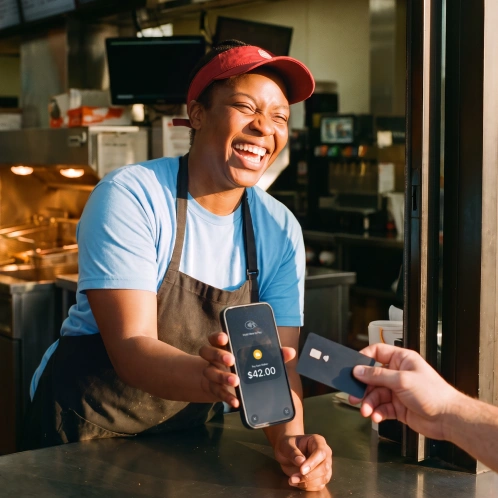
For an auto glass business that accepts payments on-site, JIM fits the mobile payment need directly. You accept debit, credit, and digital wallets through your smartphone with Tap to Pay. At 1.99% per transaction with no hidden costs or extra hardware, it keeps more money in your pocket. Getting started takes three steps: download the JIM app for iOS, type the sales amount and hit sell, and your money is available on your JIM card as soon as the sale completes.
Consider an alternative processor only if you need capabilities JIM does not cover, such as invoicing with net 30 terms or integration with specific accounting software. For on-site card acceptance, Tap to Pay at 1.99% covers the core need.
Action items
- Decide on your payment terms for individual versus fleet customers.
- Compare the transaction fees of at least two different payment solutions.
- Download the JIM app to see how Tap to Pay works on your phone.
How do you fund your business and manage finances?
Secure $17,000 to $42,000 in startup capital through SBA microloans or equipment financing, and keep $15,000 to $25,000 in working capital for your first six months.
Secure startup capital
The SBA Microloan program is a good starting point. It offers loans up to $50,000, and lenders often work with new businesses. Interest rates generally range from 8% to 13%, and terms extend up to six years. You typically need a credit score of 680 or higher to qualify.
Another route is equipment financing. Lenders like Crest Capital focus on this, and it can be easier to get because the van and tools serve as collateral. This frees up your cash for other expenses instead of a large one-time purchase.
Budget for your first six months
With funding in place, plan for working capital. This is the cash that covers daily operations before you have consistent income. A common mistake is to focus only on startup costs and run out of money for operations.
For example, a solo operation might burn $2,500 per month: van insurance $150, phone and dispatch software $120, fuel $400, advertising $500, rent $800, and owner's draw $530. Multiply your monthly burn by six to set your working capital floor.
Keep $15,000 to $25,000 set aside for your first six months. Open a dedicated business checking account immediately. Keeping your finances separate from personal accounts makes tax season simpler and is a requirement for most business loans.
Action items
- Check your credit score to see if you meet SBA Microloan requirements.
- Request a quote for equipment financing from a specialized lender.
- Calculate your estimated operating expenses for the first six months.
- Open a dedicated business checking account at a local bank or credit union.
How do you hire your team and set up operations?
Hire one AGSC-certified technician at $45,000 to $65,000 per year, and use trade-specific software to manage dispatch and invoicing from day one.
Build your technical team
Your first hire is an Auto Glass Technician responsible for mobile repairs and replacements. A competitive salary for a skilled tech falls between $45,000 and $65,000 annually. Require an active AGSC certification to ensure safe, quality work.
Set up your workflow
One technician can handle 3 to 5 jobs per day. To avoid scheduling conflicts and missed appointments, use software built for the trade. Programs like ServiceTitan or Glas-Avenue manage dispatch, invoicing, and customer updates from a single platform.
This efficiency connects directly to revenue. At 3 to 5 jobs per day, 5 days per week, and an average ticket of $150 to $200, a full-time technician generates $117,000 to $260,000 in annual sales. Use $150,000 to $200,000 as a conservative planning target to set clear financial goals and track performance from day one.
Action items
- Draft a job description for an Auto Glass Technician that lists AGSC certification as a requirement.
- Research local technician salaries to finalize your pay range.
- Schedule a demo with an industry-specific software like ServiceTitan.
- Calculate your first-year revenue goal using the $150,000 per technician planning target.
How do you market your business and get customers?
Build a complete Google Business Profile, establish referral partnerships with local auto shops, and run targeted Google Ads with a strict daily budget.
Establish your digital storefront
Your Google Business Profile is your most powerful free marketing asset. Fill it out completely with photos and service areas. Actively ask every customer for a review. A steady stream of 4- and 5-star reviews gets you noticed.
Forge local partnerships
Reach out to auto body shops, car washes, and detailers. Offer them a referral fee of $20 to $40 for every customer they send your way. This creates a reliable pipeline of work that costs you nothing upfront.
Fleet accounts and dealership work provide consistent revenue that individual car owners cannot. Do not overlook B2B clients. They can become the backbone of your business, providing steady jobs week after week.
Run targeted online ads
With Google Ads, target people searching for "windshield replacement [your city]." A typical auto-services cost-per-click runs $5 to $12. At a 10% conversion rate, your customer acquisition cost lands between $50 and $120 per job. Set a strict daily budget of $25 to avoid overspending as you learn.
Action items
- Set up and fully complete your Google Business Profile.
- Create a simple flyer offering a referral fee to local auto businesses.
- Identify three local fleet managers to contact for potential partnership.
- Set a daily budget of $25 for a trial Google Ads campaign.
How do you set your pricing and profit margins?
Charge $75 to $150 for chip repairs and apply a 100% to 200% markup on replacement glass, with a labor rate of $85 to $125 per hour.
For simple chip repairs, a flat-rate price between $75 and $150 works well. For full replacements, use a cost-plus model: calculate the cost of the glass and materials, add your labor, then apply a markup.
Target a 100% to 200% markup on the wholesale cost of the glass. If a windshield costs you $200, bill the customer $400 to $600 for the part. Your labor rate should be $85 to $125 per hour.
Research your competitors' pricing
To see what your market will bear, call a few local competitors. Ask for a cash quote to replace the windshield on a popular car, like a Toyota Camry. This gives you a real-world baseline. Also, get familiar with the National Auto Glass Specifications (NAGS) catalog.
NAGS provides industry-standard part numbers, suggested retail prices, and labor time estimates. Insurance companies use it, so it is a good reference for setting your own rates. It helps ensure your quotes are competitive and profitable.
Avoid common pricing mistakes
Underpricing your services to get work is a fast track to failure. Another frequent oversight is forgetting to charge for ADAS recalibration. Modern windshields have cameras that need recalibration after replacement, a service that can add $250 or more to the invoice.
Action items
- Call three local competitors for a cash quote on a windshield replacement.
- Calculate a sample job price using a 150% markup on glass and a $100 per hour labor rate.
- Find the NAGS suggested labor time for a common vehicle.
- Research what local dealerships charge for ADAS recalibration services.
How do you maintain quality and scale your operations?
Track a comeback rate under 2%, and hire a second technician when your first tech consistently completes 20 to 25 jobs per week.
Establish your quality standards
Your comeback rate is your most important quality metric. This is the percentage of jobs that need a second visit due to issues like leaks or wind noise. Aim for a comeback rate under 2%. Ensure every technician holds an active AGSC certification.
Track this data proactively. Send a simple follow-up survey after each job to catch issues before they become negative reviews. This helps you maintain a high standard of service from the start.
Track your shop health score
Monitor five KPIs to know whether your operation is healthy:
- Comeback rate: under 2%
- Jobs per technician per week: 20 to 25 at capacity
- Average ticket: $150 to $200 for replacements, $75 to $150 for chip repairs
- Gross margin on replacements: 40% to 60% (glass cost plus labor versus billed price)
- Review velocity: 2 or more new Google reviews per week
Review these weekly. If your comeback rate rises above 2% or jobs per tech drop below 15, investigate the root cause before it damages your reputation.
Know when to grow
Once your first technician consistently completes 20 to 25 jobs per week, hire a second one. Waiting too long leads to burnout and rushed work, which drives up your comeback rate. A second technician can double your revenue capacity to the $300,000 to $400,000 range.
As you add a second van, managing schedules manually becomes difficult. Software like Glas-Avenue or ServiceTitan handles dispatch, inventory, and invoicing so you can focus on managing your growing team instead of paperwork.
Action items
- Track your comeback rate weekly with a goal to keep it under 2%.
- Create a simple customer satisfaction survey to send after each job.
- Set a hiring trigger for when your first technician reaches 20 jobs per week.
- Ensure any new technician you hire holds an active AGSC certification.
You now have a clear path to launch your auto glass business. Success in this trade comes from the trust you build with each repair, so focus on quality work and clear communication. When you get paid on-site, JIM lets you accept cards on your phone at 1.99% per transaction with no extra hardware. Download JIM and you are ready.
Frequently Asked Questions
Is an auto glass repair business profitable?
How long does it take to start an auto glass business?
Mobile auto glass or brick-and-mortar: which should you choose?
Do I need a license to repair auto glass?
How much does it cost to start an auto glass repair business?


Sell and get paid in seconds with Jim