Best credit card processing: a small business guide for 2026

- Choose a credit card processor carefully to protect your profits from high fees and slow deposits.
- Expect to pay between 1.5% and 3.5% in fees for each transaction, depending on your industry, payment method, and sales volume.
- Compare pricing models like flat-rate (simple), interchange-plus (transparent), subscription (high-volume), and tiered (often costly).
- Start accepting payments by selecting a processor, applying for a merchant account, setting up your system, and running a test transaction.
Credit card processing fees take 1.5% to 3.5% out of every sale, and the wrong processor can cost a small business thousands of dollars a year. The Federal Reserve Bank of Boston found that 80% of U.S. small businesses face challenges with payment systems, citing credit card processing fees and slow payments as top pain points. Your choice of small business payment processor directly controls how much of each sale you keep and how fast cash reaches your account.
Understanding credit card processing costs
Credit card processing costs are the fees a merchant pays on every card transaction, typically 1.5% to 3.5% of the sale amount. Three layers make up that total: the interchange fee set by the card networks, a smaller network assessment, and the processor's markup.
How much are typical processing fees?
Small businesses pay between 1.5% and 3.5% per transaction, depending on card type, industry, and how the card is accepted. Visa's published interchange rates set the base cost that every processor pays, and the processor adds its markup on top. Manually entered (keyed) transactions carry a higher interchange rate than swiped or tapped cards, which is why online and phone sales cost more to process.
Key factors that influence your rates
- Industry type: higher-risk sectors such as travel, subscriptions, and firearms pay higher interchange and markup.
- How you accept the payment: in-person contactless (tap, chip) is cheapest; keyed-in and online transactions cost more.
- Average transaction size and monthly volume: larger tickets and higher volume often unlock lower effective rates.
- Card type: debit cards cost less than standard credit, which costs less than premium rewards and corporate cards.
Comparing credit card processing pricing models
The pricing model a processor uses determines whether your costs stay flat or swing month to month. The right model depends on your monthly card volume: below roughly $50,000, flat-rate wins on simplicity and predictability; above that, interchange-plus usually wins on total cost.
| Pricing model | How it works | Cost on a $50 in-person sale (example) | Deciding criterion |
|---|---|---|---|
| Flat-rate | One percentage plus a fixed fee on every sale | $0.99 at 1.99% (JIM) | Under $50K/month, new businesses |
| Interchange-plus | Interchange plus a disclosed markup | $0.92 to $1.05 (varies by card) | Over $50K/month, established businesses |
| Subscription | Fixed monthly fee plus interchange and a small per-sale fee | $0.80 plus the monthly fee | Over $100K/month, high volume |
| Tiered | Transactions sorted into qualified, mid, non-qualified | $1.10 to $1.50 (unpredictable) | Avoid unless you can audit tiers |
The $50 figures above are illustrative examples, not quotes. Actual costs depend on the card mix and processor markup.
Flat-rate pricing
Flat-rate pricing bundles interchange, assessments, and markup into a single percentage plus a fixed per-transaction fee. You pay the same rate regardless of card type. It is a low-risk choice for businesses processing under $50,000 per month, because statements stay predictable. The trade-off is that flat-rate becomes more expensive than interchange-plus once volume grows.
Interchange-plus pricing
Interchange-plus passes the exact interchange and assessment cost through to you and adds a disclosed markup. Monthly statements show the true cost of every card. This model is usually the cheapest option for established businesses processing more than $50,000 per month, but costs fluctuate with the card mix.
Subscription-based pricing
Subscription (membership) pricing charges a fixed monthly fee in exchange for interchange plus a small per-transaction cost. It can deliver the lowest total cost for businesses processing over $100,000 per month. The monthly fee applies even in a slow month, so it hurts low-volume sellers.
Tiered pricing
Tiered plans sort transactions into "qualified," "mid-qualified," and "non-qualified" tiers, each with a different rate. The processor decides which tier each transaction falls into, which makes statements hard to audit.
Suppose a cafe runs a $100 rewards-card sale that the processor drops into the "non-qualified" tier at 3.5% instead of the "qualified" rate of 1.8%. That single sale costs $3.50 instead of $1.80, a 1.7 percentage-point jump the owner cannot predict at the time of sale. Over 200 similar sales a month, the gap adds up to $340. Avoid tiered pricing unless you can audit every transaction's tier assignment.
How processors compare on cost and speed
A "best" list only helps when the comparison uses equivalent conditions. The table below lists each processor's published U.S. rate, monthly fee, and deposit speed as of August 2026.
| Processor | Pricing model | In-person rate | Online rate | Monthly fee | Deposit speed |
|---|---|---|---|---|---|
| JIM | Flat-rate | 1.99% | 4.99% + $0.30 | $0 | Instant to JIM Card; same business day to bank |
| Square | Flat-rate | 2.6% + $0.15 | 2.9% + $0.30 | $0 | One to two business days |
| Stripe | Flat-rate / interchange-plus | 2.7% + $0.05 | 2.9% + $0.30 | $0 | Two business days (instant payout available) |
| PayPal Zettle | Flat-rate | 2.29% + $0.09 | 3.49% + $0.49 | $0 | Instant to PayPal balance; one business day to bank |
| Helcim | Interchange-plus | Interchange + 0.40% + $0.08 | Interchange + 0.50% + $0.25 | $0 | Two business days |
Source: JIM Help Center. Source: Square's official website, accessed August 2026. Source: Stripe's official pricing page, accessed August 2026. Source: PayPal's official website, accessed August 2026. Source: Helcim's official website, accessed August 2026. Rates reflect each processor's published U.S. pricing as of August 2026; effective rates were compared on equivalent in-person and online transactions.
How to start accepting credit card payments
Getting set up to accept credit card payments takes four steps.
Choose the right processor for your business
Compare processors on effective rate (total fees divided by total card sales), monthly fees, deposit speed, and integration with your point-of-sale or e-commerce platform. Pick the model that matches your monthly volume threshold from the table above.
Apply for your merchant account
A merchant account is a specialized bank account that holds funds from your card sales before they transfer to your business checking account. Processors ask for your business license, tax ID, and banking details during the application. Sole proprietors can apply with a Social Security Number instead of an EIN.
Set up your payment systems and hardware
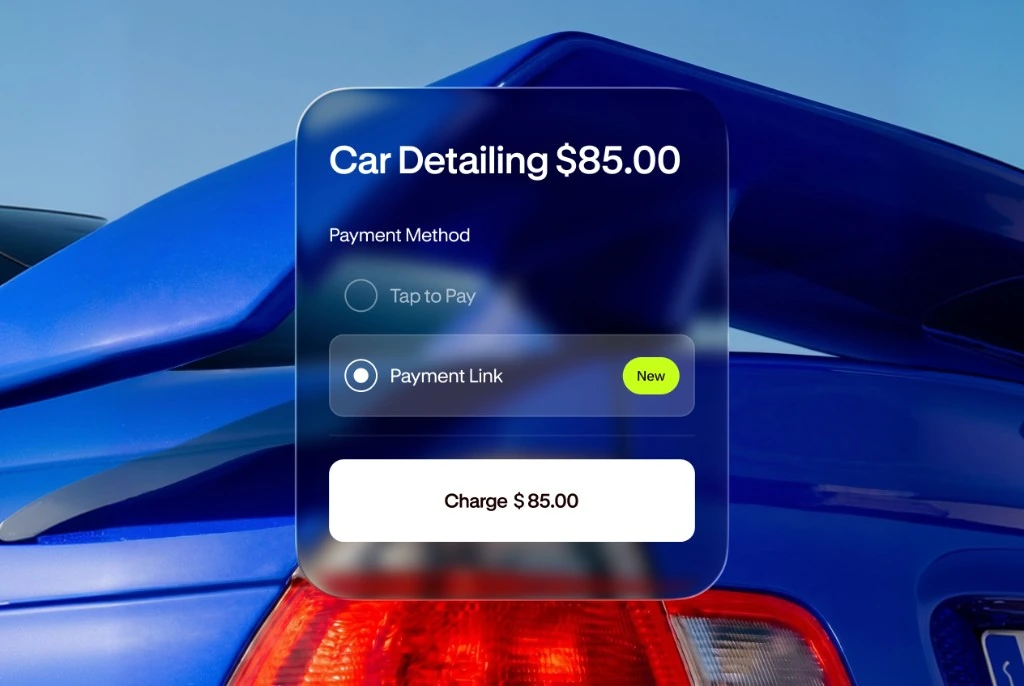
If you sell in person, connect your card reader or POS terminal. For e-commerce, integrate the processor's payment gateway into your website. JIM skips the hardware step: install the app, enter the sale amount, and accept contactless taps directly on your phone.
Test your system before going live
Run a small test transaction on your own card before opening to customers. This confirms the system works and that funds reach your account. With JIM, the test is complete in under a minute: enter the amount, tap your card, and confirm the balance appears on your JIM Card.
Hidden fees to watch for
Beyond the published rate, processors can add charges that inflate your effective rate. Ask about each of these before signing: monthly minimum fees (charged if volume falls below a threshold), PCI compliance fees for meeting Payment Card Industry security standards, chargeback fees per disputed transaction (commonly $15 to $25), early termination fees on long contracts, and batch or address-verification fees that add up over thousands of sales.
How fast do processors deposit funds?
Deposit speed matters as much as the rate, because slow deposits force you to bridge payroll and inventory costs out of pocket. JIM makes funds available instantly on the JIM Card after every sale; bank transfers via ACH arrive the same business day. Square and Stripe pay out in one to two business days, and Helcim in two business days. If cash flow is tight, prioritize a processor with instant or same-day access.
Key takeaways
- Match the pricing model to your volume: flat-rate under $50,000 per month, interchange-plus above it.
- Compare the effective rate, not the headline percentage, and audit for hidden fees.
- Deposit speed is a cash-flow variable: instant access beats a two-day wait.
- JIM charges a flat 1.99% per in-person Tap to Pay sale, with no monthly fee, no hardware, and instant access to funds on the JIM Card.
If you sell in person and want the lowest published flat rate with no hardware, calculate your potential savings with JIM's flat-rate pricing.
Frequently Asked Questions
Which payment processor is best for small business?
Which credit card processing is cheapest for small business?
What is the best credit card machine for small business?
Can I accept credit cards without a registered business?
How fast do I receive my money after a card sale?



Sell and get paid in seconds with Jim