How to Start a Fast Food Business in 2026: A 10-Step Guide
See article summary
- Expect $75,000 to $350,000 to launch a fast food spot, depending on concept and size.
- Most owners form an LLC, get a free EIN from the IRS, and secure a food service license.
- Plan for six months of working capital before you expect to turn a profit.
- Food cost should stay under 35% of menu price; labor around 30% of revenue.
- A pop-up or food truck lets you validate demand before you sign a lease.
The U.S. fast food industry, also known as the Quick Service Restaurant or QSR segment, reached an estimated $423.7 billion in revenue in 2026, driven by steady demand for quick, convenient meals from busy families, students, and late-night crowds. Source: IBISWorld Fast Food Restaurants in the U.S..
Below: the exact 10 steps, cost ranges by concept type, and permit timelines to open a fast food spot in the U.S.
How do you validate a fast food concept before spending money?
Confirm people want your food before you sign a lease. A $500 pop-up at a local food festival or farmers market gives you two weekends of real sales data, which beats any survey. Pair that with Google Trends to see which food concepts are popular in your specific city.
Next, size up the competition. Use Google Maps to find every restaurant within a one-mile radius. A frequent mistake is to only look at other fast food spots, but that local pizza place or cafe is also your competition. Visit them during lunch and dinner rushes to observe their customer flow.
Break down your startup costs by concept type
Your initial investment depends heavily on your concept. A food truck, a counter-service spot, and a drive-thru restaurant have very different cost structures. A detailed budget is your roadmap. Set aside at least six months of operating expenses before you expect to build momentum.
Here is a cost breakdown by concept archetype to get you started:
| Concept | Kitchen Equipment | Lease and Renovation | Licenses and Permits | Initial Inventory | Total Range |
|---|---|---|---|---|---|
| Food truck | $20,000 - $60,000 | $40,000 - $150,000 (truck) | $1,000 - $5,000 | $2,000 - $3,000 | $50,000 - $150,000 |
| 1,500 sqft counter-service | $30,000 - $80,000 | $15,000 - $60,000 | $500 - $5,000 | $5,000 - $15,000 | $75,000 - $200,000 |
| Drive-thru restaurant | $50,000 - $150,000 | $50,000 - $150,000 | $1,000 - $5,000 | $10,000 - $20,000 | $150,000 - $350,000 |
Here are 3 immediate steps to take:
- Use Google Trends to compare search interest for two different menu ideas in your target zip code.
- Visit three local competitors, noting their prices, speed of service, and busiest times.
- Create a spreadsheet to budget for major startup costs like equipment and your first month's rent.
What licenses do you need to open a fast food restaurant?
Most new owners form a Limited Liability Company, or LLC, a business structure that protects your personal assets if the business faces debt or lawsuits. Profits pass through to your personal taxes, which avoids the double taxation you would see with a C Corporation. Source: IRS Limited Liability Company (LLC).
Once your LLC is registered with the state, get an Employer Identification Number, or EIN, your business's federal tax ID. You need it to open a bank account and hire employees. The application is free and instant on the IRS EIN application page.
Navigate your permits and licenses
Your city or county health department is your next stop. You will need a food service license, which can cost between $100 and $1,000 depending on your jurisdiction. Many people underestimate the timeline here; start this process 90 days before you plan to open, as it involves multiple inspections. The FDA publishes the Food Code, a model that most state and local health departments adopt, so review it to understand the standards your kitchen must meet.
In addition, you will need a general business license from your city, and all staff must have a food handler's permit. These permits typically cost under $20 per person. If you plan to have an outdoor sign, you will also need a sign permit.
Here are 4 immediate steps to take:
- Register your business as an LLC with your Secretary of State's office.
- Apply for a free Employer Identification Number (EIN) on the IRS website.
- Contact your local health department to request the food service license application packet.
- Research your city's requirements for a general business license and sign permit.
What insurance does a fast food business need?
Choose the right insurance policies
You will need a general liability policy with at least $1 million in coverage, and it must include product liability, which protects you if a customer claims they got sick from your food. According to Insureon's restaurant insurance data, restaurant general liability averages about $141 per month, or roughly $1,691 per year, while a Business Owner's Policy, or BOP, a bundled package that combines general liability and commercial property, averages about $251 per month, or $3,010 per year. Source: Insureon's official website, accessed August 2026.
Commercial property insurance protects your building and equipment from events like fire or theft. Workers' compensation is legally required once you hire your first employee. It covers medical bills and lost wages from on-the-job injuries, a frequent occurrence in kitchens.
Instead of a general agent, contact a specialist. Providers like The Hartford, Insureon, and the Food Liability Insurance Program (FLIP) understand restaurant risks. They can bundle policies into a BOP, which often saves money.
Understand your unique risks
Fast food kitchens have specific hazards. Grease fires are a constant threat, and wet floors create slip-and-fall risks for both staff and customers. Proper training and clear procedures are your first line of defense, but insurance is the necessary backstop for when accidents happen.
Here are 4 immediate steps to take:
- Request quotes for a $1 million general liability policy from three different providers.
- Confirm with each provider that product liability coverage is included in their quote.
- Contact a restaurant insurance specialist like The Hartford or FLIP to ask about a Business Owner's Policy.
- List your major equipment with estimated replacement costs for your commercial property insurance application.
How do you choose a location and buy equipment?
A typical fast food restaurant needs 1,500 to 2,500 square feet. On your city's planning department website, look for properties zoned for commercial use, often labeled C-1 or C-2. Prioritize spots with high visibility and foot traffic near busy intersections or shopping centers.
When you negotiate your lease, ask for a Tenant Improvement (TI) allowance, money a landlord gives a tenant to fund build-out costs, typically $10 to $40 per square foot. Many new owners sign a five-year lease without an early termination clause, a costly mistake if the location underperforms. Evaluate any lease against five factors: foot traffic, visibility, TI allowance, exit clause, and rent-to-projected-sales ratio. Keep your rent under 10% of your projected gross sales to protect your margins.
Stock your kitchen
You can save significantly by purchasing used equipment from restaurant auction sites. A new commercial fryer might cost $1,500, but a used one could be half that. A flat-top grill runs from $2,000 to $5,000. You will also need a three-compartment sink and commercial refrigeration.
For your initial inventory, check out suppliers. Restaurant Depot requires a free membership but has no minimum order, which is perfect when you start. Larger distributors like Sysco or US Foods may require a minimum weekly spend of $500 or more.
Here are 4 immediate steps to take:
- Research three potential locations and check their zoning classification on your city's planning department website.
- Ask a commercial real estate agent about typical Tenant Improvement (TI) allowances in your target area.
- Compare prices for a commercial fryer and grill from both new and used equipment suppliers.
- Sign up for a free membership at Restaurant Depot to browse inventory and pricing.
How do you set up your payment system?
Your customers expect to pay quickly. You need a system that accepts credit, debit, and digital wallets like Apple Pay, with low transaction fees and reliable uptime, because any downtime means lost sales.
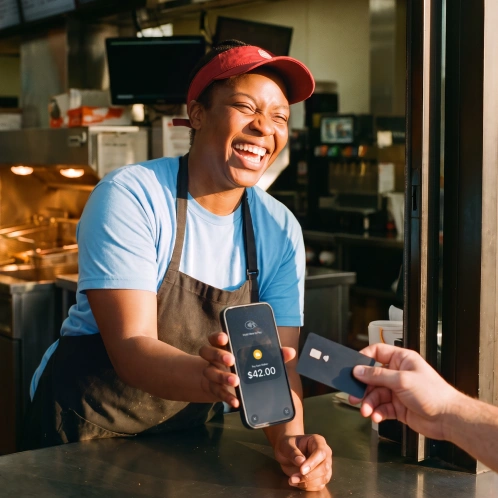
For fast food businesses that need to accept payments on-site or on-the-go, JIM offers a streamlined solution. With JIM, you can accept debit, credit and digital wallets directly through your smartphone, just tap and done.
At just 1.99% per transaction with no hidden costs or extra hardware needed, it is particularly useful for food trucks or for taking orders in a long line. Many processors charge 2.5% to 3.5% plus other fees, so the savings add up. Your deciding criterion is whether you need a traditional POS with kitchen display and inventory tracking, or whether Tap to Pay on a phone covers your order volume. If you run a high-volume drive-thru, consider an integrated restaurant POS. If you run a food truck, pop-up, or counter-service spot under roughly $50,000 a month in card volume, JIM covers the operation.
Getting started is straightforward:
- Get Started: Download the JIM app for iOS.
- Make a Sale: Type the sales amount, hit sell, and ask your customer to tap their card or device on your phone.
- Access Funds: Your money is available right on your JIM card as soon as the sale is done, no waiting for bank transfers.
Here are 3 immediate steps to take:
- Calculate your estimated monthly revenue to compare transaction fees from different payment solutions.
- Decide if you need a mobile payment option for a food truck, pop-up, or line-busting.
- Download the JIM app to see how the interface works on your phone.
How do you secure funding and manage your finances?
Find the right funding source
The SBA 7(a) loan is a popular choice for new restaurants. The maximum loan amount is $5 million, and interest rates are negotiated between you and the lender but capped by SBA maximums pegged to the Prime rate. For loans up to $50,000, the maximum rate is Prime plus 6.5%; for $50,001 to $250,000, Prime plus 6.0%; for $250,001 to $350,000, Prime plus 4.5%; and for loans greater than $350,000, Prime plus 3.0%. Source: SBA 7(a) loan program.
If your credit history is not perfect, equipment financing is another path. Because the equipment itself acts as collateral, these loans can be easier to obtain. The interest rates are higher, usually between 8% and 20%, but it gets the gear in your kitchen.
Plan your working capital
Working capital, the cash you need to cover day-to-day operating expenses like rent, payroll, and inventory before you turn a profit, is where most new owners run short. Plan to have at least six months of operating expenses in the bank.
For a small fast food spot, this means having $50,000 to $100,000 in the bank on day one. If you are still weighing your business structure or funding path, our guide to starting a small business walks through LLC setup, EIN, and financing in more detail. Also, look into grants from the National Restaurant Association Educational Foundation, which awards over $1.2 million in scholarships each year. They are competitive but worth the application if you qualify. Source: NRAEF education and scholarships.
Here are 3 immediate steps to take:
- Check the SBA website for current 7(a) loan requirements to see if you qualify.
- Calculate six months of your estimated operating expenses to set a working capital goal.
- Get a quote for equipment financing to compare its costs against a traditional loan.
How do you hire your team and set up operations?
You will likely need two primary roles: cooks and cashiers, who typically earn $15 to $18 per hour. Many owners try to manage every shift themselves at first, but this leads to burnout. Consider hiring a reliable shift lead early on for around $20 to $25 per hour.
All employees must have a food handler's permit. For your shift lead or manager, you might want to get them ServSafe certified. This program covers advanced food safety and is a standard in the restaurant industry, which can help lower your insurance premiums.
Streamline your daily workflow
To manage schedules and control labor costs, look into software like 7shifts or Homebase. These platforms help you build schedules, track hours, and communicate with your team from an app. They prevent over-staffing, which can quickly eat into your profits.
Aim to keep your total labor expenses close to the industry benchmark. According to the National Restaurant Association, salaries and wages represented a median of 31.7% of sales among limited-service restaurants in 2024, and profitable operators kept labor even lower at about 30.0%. Source: National Restaurant Association restaurant labor cost data. Using scheduling software makes it much easier to stay within that target range as you adjust to sales volume.
Here are 4 immediate steps to take:
- Draft job descriptions for a cook and a shift lead, including pay ranges.
- Research ServSafe manager certification courses and costs in your area.
- Explore the features of scheduling software like 7shifts or Homebase.
- Set a target labor cost percentage for your first six months of operation.
How do you launch your marketing and attract customers?
Build your local presence
Your first customers will come from your neighborhood. A grand opening event with a simple offer, like a free drink with any purchase, can create initial buzz. Also, consider partnering with nearby offices for a lunch discount program. Owners who overlook this miss out on consistent weekday traffic.
Print 1,000 high-quality flyers with a compelling offer and distribute them in the surrounding blocks. A 1-2% redemption rate is a solid return. Focus your message on one signature item to avoid overwhelming potential customers with too much information.
Use digital ads to reach new people
Claim your Google Business Profile immediately. It is free and puts you on the map. Encourage your first few happy customers to leave reviews. For paid ads, start with a small budget of $15-$20 per day on Facebook or Instagram, targeting users within a two-mile radius.
Your ad is only as good as your food photography. You do not need a professional photographer at first. A clear photo taken on a smartphone in good lighting works well. A common mistake is running ads with dark, unappetizing pictures, which wastes your budget.
Here are 4 immediate steps to take:
- Claim and fully complete your Google Business Profile with hours, menu, and photos.
- Design a grand opening flyer with a single, clear offer.
- Contact two local businesses or office buildings to propose a partnership.
- Set up a Facebook ad campaign with a $15 daily budget targeting your local zip code.
How do you set menu prices and manage food costs?
Your menu prices directly impact your profitability. The goal for most fast food spots is to keep the food cost percentage between 28% and 35%. This means the ingredients for an item should cost no more than 35% of its menu price.
Calculate your cost per item
To set a price, you must know the exact cost of every ingredient in a dish. For example, if a burger's ingredients cost you $2.50, you can use a cost-plus pricing model. A common approach is to multiply your food cost by three, which would price the burger at $7.50. If burgers are your signature item, our guide to starting a burger business breaks down concept validation and pricing in more detail.
A frequent mistake is just copying a competitor's prices. You do not know their ingredient costs, rent, or labor expenses. Always base your prices on your own numbers first, then adjust based on what the local market will accept.
Engineer your menu for profit
Once you set prices, analyze your menu. You can categorize items into stars (high profit, high popularity) and puzzles (high profit, low popularity). Promote your stars heavily. For puzzles, you might try a special or a combo meal to see if you can increase their sales.
Here are 4 immediate steps to take:
- Calculate the exact ingredient cost for your signature menu item.
- Use a 3.5x markup to set an initial price for that item.
- Compare your price to three direct competitors to see if it is competitive.
- Set a target overall food cost percentage for your restaurant, aiming for under 35%.
Is a fast food business profitable, and when should you scale?
Establish your quality standards
Consistency is what brings customers back. Document every recipe with exact measurements and procedures. Aim for an order accuracy rate of 99% or higher and keep ticket times under five minutes during peak hours. Use these metrics to train your team and evaluate performance daily.
Before you expand, create a detailed operations manual. This playbook should cover everything from food prep to customer service scripts. It ensures your second location runs just as smoothly as your first.
Know when to grow
Growth should be data-driven, not based on a gut feeling. A good benchmark to consider expansion is after you have achieved 12 consecutive months of profitability. You should also have a net profit margin of at least 15% and enough cash to cover the new location's startup costs.
Once you are ready to scale, inventory and sales management software becomes very helpful. An all-in-one restaurant management system can manage multiple locations from one dashboard, tracking sales data, inventory levels, and labor costs to give you a clear picture of your entire operation.
Here are 4 immediate steps to take:
- Create a recipe card for your top-selling item with exact measurements and photos.
- Start tracking your average ticket time and order accuracy for one week.
- Draft a one-page operations summary that a new hire could follow.
- Research the features of an all-in-one restaurant management system built for multi-location operations.
You now have a roadmap to launch your fast food business. Your next step is concrete: pick one concept archetype from the cost table, map its startup budget to your savings or loan pre-qualification, and call your local health department this week to request the food service permit packet.
And when you open your doors, a simple payment process helps. JIM lets you accept cards and digital wallets right on your smartphone, with no extra hardware and a flat 1.99% fee. Download JIM to be ready for your first sale.
Frequently Asked Questions
How much does it cost to open a fast food restaurant?
Is a fast food business profitable?
How long does it take to open a fast food restaurant?
Should I franchise or start independent?
Do I need a food service license to sell fast food?


Sell and get paid in seconds with Jim