How to start a golf apparel company: go from idea to launch
See article summary
- Launch a golf apparel brand for $15,900 to $39,800, covering inventory, site, legal, insurance, and gear.
- Form an LLC ($35 to $500 by state), get a free EIN, and follow FTC textile labeling rules.
- Source a focused capsule collection from a manufacturer with a clear tech pack and sample run.
- Price with a landed cost model and aim for 60 to 70% gross margin on premium pieces.
- Sell online and at pro shops or tournaments, accepting card payments with JIM at 1.99% per tap.
Starting a golf apparel company turns a passion for the sport and fashion into a business with real demand behind it. The global golf apparel market reached $4.4 billion in 2024 and is projected to grow to $6.6 billion by 2030, fueled by casual players, club members, and touring professionals. Source: Grand View Research golf apparel market report.
A successful launch takes roughly 90 to 120 days from concept to first sale. You will validate demand, set up a legal entity, secure insurance, source a capsule collection, build an e-commerce store, and line up in-person selling channels. This guide walks through each step with the costs, thresholds, and primary sources you need to make confident decisions.
How do you validate a golf apparel business idea?
Validate the idea by surveying at least 50 golfers directly and analyzing three competitors before you spend on inventory. Direct feedback from real players tells you what they wear, what they lack, and what they would pay for premium pieces, which no generic market report can match.
Visit local golf courses, driving ranges, and pro shops. Ask players about their current apparel, fit problems, and gaps in their wardrobe. Note what brands they wear and which price points they accept. This fieldwork takes a few weekends and costs nothing, but it prevents the most common launch mistake: building a collection nobody asked for.
Next, analyze the competition. Use Google Maps to list every golf apparel brand selling in your region, from major labels to smaller direct-to-consumer (DTC) operators. Review their websites for price ranges, fabric claims, and best-selling items. A spreadsheet tracking three to five competitors gives you a realistic view of the market you are entering.
Map out your startup costs
Initial capital needs careful planning, and the biggest mistake is over-investing in a wide range of products. Start with a focused capsule collection of 6 to 12 stock keeping units (SKUs), which requires an inventory budget of $10,000 to $25,000 to test the market. These figures are planning estimates, not a quote, so ground them in a supplier sample and a landed cost calculation before you commit.
Beyond inventory, budget for the other key areas. A professional e-commerce site on Shopify runs $2,000 to $7,000. Set aside $3,000 to $5,000 for your initial marketing push, $500 to $1,500 for business registration, and $400 to $700 for general liability insurance. Here is how a typical launch budget comes together.
<rich-table>| Cost category | Low end | High end || --- | --- | --- || Capsule inventory (6 to 12 SKUs) | $10,000 | $25,000 || E-commerce site (Shopify) | $2,000 | $7,000 || Initial marketing | $3,000 | $5,000 || Business registration and permits | $500 | $1,500 || General liability insurance (annual) | $400 | $700 || In-house customization gear | $500 | $1,300 || Estimated total to launch | $16,400 | $40,500 |
These ranges reflect a small U.S. launch and assume you negotiate a short lease and handle fulfillment in-house. Your final number depends on supplier minimums, your state's filing fees, and how much of the work you do yourself.
Your next three moves:
- Survey at least 50 golfers at local clubs or driving ranges.
- Build a spreadsheet of three to five competitors with their price ranges.
- Draft a launch budget using the categories above, then get a supplier quote for one capsule item.
How do you set up a legal structure and get licensed?
Form a Limited Liability Company (LLC) because it separates your personal assets from business debts and lawsuits, a protection a sole proprietorship does not offer. An LLC also provides pass-through taxation, so profits are taxed on your personal return, which avoids the double taxation of a C Corp. For a broader walkthrough of entity choices and registration, see our guide to start a business.
Filing fees vary by state. According to the Small Business Administration, the total cost to register your business is usually under $300, but state filing fees for an LLC range from $35 in Montana to $500 in Massachusetts. Source: SBA launch your business guide. Check your Secretary of State's website for the exact fee and process.
Secure your permits and tax IDs
Get an Employer Identification Number (EIN) from the IRS. It is free, you apply online, and processing is immediate. You need this number to file taxes and open a business bank account. Source: IRS get an employer identification number.
Next, obtain a seller's permit from your state's department of revenue so you can collect sales tax. Check with your city or county clerk for a local business operating license, which usually costs $50 to a few hundred dollars annually.
Finally, follow Federal Trade Commission (FTC) rules for apparel. The Textile Fiber Products Identification Act requires you to label garments with fiber content, country of origin, and your business identity. Source: FTC threading your way through the labeling requirements. This is a non-negotiable compliance step.
Your next four moves:
- File for an LLC with your state's Secretary of State office.
- Apply for a free EIN on the IRS website.
- Register for a state seller's permit to collect sales tax.
- Review the FTC's textile labeling guide before you order labels.
How do you insure a golf apparel company and manage risk?
Secure general liability insurance with at least $1 million in coverage, because it protects against common third-party risks like a customer injury at a pop-up event. According to Insureon, small businesses pay an average of $45 per month, or $538 per year, for general liability, with apparel retailers falling in a similar range. Source: Insureon general liability insurance cost. Premiums vary by revenue, state, and coverage limits.
General liability does not cover problems with your products. For that, you need product liability insurance, which covers claims if your apparel causes harm, such as an allergic reaction to a dye. Expect to pay $500 to $2,000 annually for this policy, depending on your sales volume.
Also consider commercial property insurance to protect your inventory from theft or damage. If you hire employees, you must carry workers' compensation insurance, and if you use a vehicle for business deliveries, you need a commercial auto policy.
Find the right insurance provider
Work with an insurer that understands e-commerce and apparel, because a general agent may miss risks like inventory valuation or supply chain disruption. Providers such as The Hartford, Hiscox, and Chubb have experience with online retail and can bundle general liability, product liability, and property coverage into a business owner's policy (BOP). Compare at least two quotes and confirm that product liability is included, not sold separately.
Your next four moves:
- Get a quote for a $1 million general liability policy.
- Confirm product liability is included in the quote.
- Ask about commercial property coverage for your inventory value.
- Compare quotes from at least two providers that specialize in e-commerce.
How do you source a space and production gear?
Find a small commercial space of 500 to 800 square feet with commercial zoning that permits light storage and shipping. Some new owners sign long-term leases too soon. Negotiate a shorter 1- to 2-year lease to keep flexibility while you test demand.
For in-house customization, you will need a heat press ($300 to $800), a shipping scale ($50 to $150), and a thermal label printer ($150 to $300). These tools streamline order fulfillment from day one and pay for themselves within the first few hundred orders.
Source your apparel and build a tech pack
When you look for apparel suppliers, platforms like Alibaba connect you with manufacturers, but a private label manufacturer gives you more control over fabric, fit, and branding. Be prepared for minimum order quantities (MOQs) of 50 to 200 units per style. Always order a sample size run to verify quality and fit before you place a bulk order.
Prepare a tech pack for each style, which is a document that specifies fabric, measurements, stitching, labels, and packaging. A clear tech pack reduces sampling rounds and prevents costly production errors. Golf apparel favors performance fabrics, so specify moisture-wicking polyester or polyester-spandex blends and note any UPF sun protection rating, which matters to golfers who spend four to five hours on the course.
Your next four moves:
- Research local commercial listings for 500 to 800 square foot spaces.
- Get quotes for a heat press and a thermal label printer.
- Request a tech pack template from one potential private label manufacturer.
- Ask two suppliers about MOQs and sample costs for your first capsule.
How do you set up payment processing?
Your e-commerce platform will have a built-in payment processor, like Shopify Payments or Stripe, which charge around 2.9% plus 30 cents per transaction for domestic cards. Source: Shopify pricing. This is your primary method for online sales, and setup is integrated into your store's dashboard. For a broader look at payment methods for small businesses, compare processor fees and settlement times before you commit.
Accept payments in person
Many new apparel founders focus only on online sales and miss opportunities at golf tournaments or pop-up events. For these situations, you need a way to accept payments on the go. Other mobile payment providers often charge high commission rates or require extra hardware.
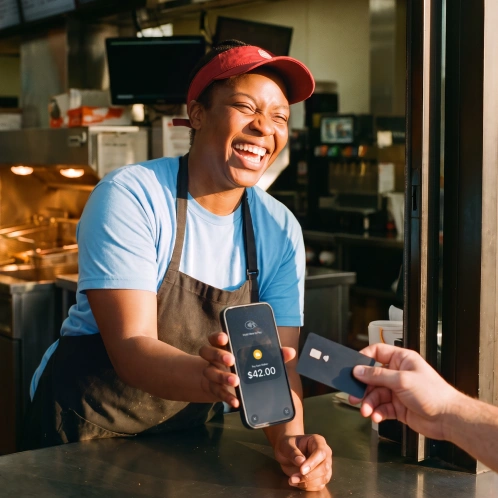
For apparel companies that need to accept payments on-site, JIM offers a streamlined solution. With JIM, you accept debit, credit, and digital wallets directly through your smartphone, with no extra hardware. At 1.99% per Tap to Pay transaction, it is useful for selling at a weekend golf event or a pro shop pop-up.
Here is how it works:
- Get started: Download the JIM app for iOS.
- Make a sale: Type the sales amount, hit sell, and ask your customer to tap their card or device on your phone.
- Access funds: Your money is available on your JIM card as soon as the sale is done.
Your next three moves:
- Compare the transaction fees of your e-commerce platform's native processor.
- Download the JIM app to prepare for in-person sales opportunities.
- List potential local events or golf tournaments where you could set up a pop-up.
How do you fund the business and manage finances?
An SBA 7(a) loan can cover initial costs, with a maximum loan amount of $5 million through the Small Business Administration's program. Source: SBA 7(a) loans. For a new apparel brand, a smaller loan or an SBA Microloan (up to $50,000) is often more realistic than the full 7(a) maximum. Loan amounts, credit thresholds, and interest rates vary by lender, so treat any range as a starting point, not a guarantee.
Plan your working capital
Many founders focus on startup costs but get caught off guard by operating expenses. You need about six months of working capital to cover inventory reorders, marketing, rent, and insurance before sales become consistent. A safe estimate is $20,000 to $40,000, depending on your overhead.
In addition to loans, look for small business grants. Search Grants.gov for federal opportunities, and contact your local Small Business Development Center (SBDC) for free, confidential advising on state-specific funding programs. Source: SBA counseling and local assistance.
Your next four moves:
- Draft a 6-month operating budget to calculate your working capital needs.
- Review the SBA 7(a) and Microloan eligibility pages on sba.gov.
- Search Grants.gov for federal small business funding opportunities.
- Schedule a free consultation with your local SBDC.
How do you hire a team and run operations?
Your first hire should be a part-time fulfillment associate to handle packing and shipping, a role that typically pays $15 to $20 per hour. This frees you to focus on marketing and product development. Avoid hiring full-time staff too quickly. Use contractors for specialized tasks like digital marketing or photography, which keeps your fixed costs low while you test sales channels.
For managing staff schedules, software like Homebase or When I Work helps coordinate shifts for part-time help. As you grow, track revenue per employee as a productivity rule of thumb. A small apparel brand often targets $150,000 in annual revenue per employee, but this varies widely by channel mix and outsourcing, so use it as a directional benchmark, not a hard target.
Your e-commerce platform, like Shopify, has built-in inventory management features sufficient for starting out. No special certifications are needed for initial hires, but attention to detail is a must for anyone handling orders and inventory.
Your next four moves:
- Draft a job description for a part-time fulfillment associate.
- Identify one task, like social media ads, to outsource to a contractor.
- Review the features of a scheduling app like Homebase.
- Set a revenue-per-employee target to guide your first full-time hire.
How do you market a golf apparel brand?
Focus your initial marketing budget on one or two channels, because spreading spend too thin wastes money. Instagram is a strong choice for apparel. Run ads targeting users interested in major golf brands or publications. A starting ad budget of $500 to $1,000 per month gathers useful data on which creative and audiences convert.
Track your metrics from the start. According to IRP Commerce, the average conversion rate for fashion, clothing, and accessories e-commerce runs around 1.5% to 3%. Source: IRP Commerce fashion ecommerce market data. If your average product price is $80, a customer acquisition cost (CAC) under $40 is a healthy goal, because it keeps your ad spend profitable at a 2% conversion rate.
Collaborate with golf influencers
Partner with micro-influencers, who are golfers with 5,000 to 20,000 followers. They often have high engagement and their fees are lower than larger creators. Offer them free products in exchange for a few posts, and track the discount codes they share to measure which partnerships drive sales.
Build an email list from day one. Use a platform like Klaviyo to offer a 10% discount for new subscribers. This creates a direct communication line to potential customers that you own, independent of social media algorithms.
Your next four moves:
- Launch an Instagram ad campaign with a $25 daily budget.
- Identify three golf micro-influencers to contact for a partnership.
- Set up an email capture form on your website with a welcome discount.
- Calculate your target CAC based on your product margins and a 2% conversion rate.
How do you price golf apparel for profit?
Calculate your landed cost per item first, which is the total expense to get a product to your door, including manufacturing, shipping, and duties. A standard apparel practice is keystone pricing, a 100% markup. For example, a polo that costs you $30 in landed cost would retail for $60.
Premium golf apparel can support higher margins. Aim for a 60 to 70% gross margin, which prices that same $30 polo at $75 to $100. Use this framework to set three price tiers for your capsule.
<rich-table>| Pricing tier | Landed cost | Retail price | Gross margin || --- | --- | --- | --- || Value | $20 | $50 | 60% || Mid | $30 | $80 | 62.5% || Premium | $45 | $120 | 62.5% |
Some new owners price too low to attract sales, but this hurts your brand's perceived value and makes it tough to be profitable. Your price signals quality. If you use superior performance fabrics or UPF-rated materials, your price should reflect that.
Analyze the market
Look at what your competitors charge. Check the websites of established brands and a few smaller DTC companies. See what they ask for similar items like performance polos or vests. This helps you find a realistic price range for your own products.
You can also use psychological pricing tactics, like setting a price at $98 instead of $100, to make the cost seem lower to the customer. Test different price points and track which ones convert best.
Your next four moves:
- Calculate the full landed cost for one of your core products.
- Research the retail prices for similar items from three competitor brands.
- Apply the three-tier framework to set a target price for each capsule item.
- Run a 30-day pricing test on one SKU to measure conversion at two price points.
How do you sell into pro shops and wholesale channels?
Selling into pro shops and country clubs is a major golf apparel channel that online-only brands often overlook. Wholesale margins are tighter than DTC, but the volume and credibility of being stocked at a club can accelerate your brand. Build a line sheet that lists each SKU, wholesale price, suggested retail, MOQ, and delivery window. Pro shop buyers expect a wholesale price at 40 to 50% of retail, so model your margins before you pitch.
Start with a handful of local clubs where you have a relationship or where your survey respondents play. Offer a small initial order and consignment terms if the buyer is hesitant. Trade shows like the PGA Merchandise Show are a route to broader distribution, but they require a finished line sheet, samples, and a production timeline that can fulfill reorders within 4 to 6 weeks.
Your next three moves:
- Build a one-page line sheet with wholesale and retail prices for your capsule.
- List five local pro shops or country clubs to pitch.
- Decide whether to invest in the PGA Merchandise Show based on your production capacity.
How do you control quality and scale operations?
Create a quality control (QC) checklist for every shipment. Inspect for consistent stitching, fabric color, and accurate sizing against your spec sheet. Aim for a defect rate below 2%, which protects your brand reputation and reduces costly returns.
Establish your growth triggers
Set clear benchmarks for expansion. When you consistently process over 300 orders per month, it is time to hire another part-time fulfillment associate. Once annual revenue approaches the $200,000 mark, you can explore a larger commercial space.
Scaling without the right systems causes problems. Before you increase production, consider inventory management software like Katana or Cin7. These platforms integrate with Shopify and offer stronger features for tracking materials and managing larger order volumes.
Your next four moves:
- Create a QC checklist to inspect every garment upon arrival.
- Set a target product return rate of under 3% due to defects.
- Define the monthly order volume that will trigger your next hire.
- Review inventory management platforms like Katana for future growth.
What is the next step after launch?
A golf apparel brand is about more than fabric and fit. The golf community values authenticity, so your story and your attention to performance details matter. You have a roadmap to validate, fund, source, price, and sell. Pick one step from the checklist above and start this week.
When you prepare for pop-up events at local courses, JIM helps you accept payments on the spot. It turns your phone into a card reader at a flat 1.99% fee, with no extra hardware, so your first in-person sale is as simple as a tap.
Frequently Asked Questions
How much does it cost to start a golf apparel company?
Do I need an LLC to sell golf apparel?
What licenses do I need for a golf apparel company?
Where do I find golf apparel suppliers?
What profit margins should I target?




Sell and get paid in seconds with Jim