How to start a paintball business: your game plan
See article summary
- Opening a paintball field costs $50,000 to $100,000 for land, gear, insurance, and permits.
- Form an LLC, get a free EIN from the IRS, and secure a conditional use permit for your land.
- Buy 50 mid-range rental setups like Tippmann 98 Customs rather than cheap off-brand markers.
- General liability insurance runs $7,000 to $15,000 a year through amusement insurance brokers.
- Paintballs carry a 300% to 500% markup and drive most of your profit, not entry fees.
Opening a paintball field in the U.S. costs $50,000 to $100,000 and takes 3 to 6 months of permit approval before your first paying group walks on. The industry serves birthday parties, corporate team-building events, and weekend enthusiasts, with steady repeat demand from groups that book the same field every season.
The steps below cover demand validation, legal setup, insurance, location and equipment, payment processing, funding, staffing, marketing, pricing, and quality control. Each section answers a question your future customers and lenders will ask, with real cost ranges and sourcing for every financial or legal claim.
How much does it cost to start a paintball business?
A paintball business in the U.S. costs $50,000 to $100,000 to launch, split across field development, rental gear, insurance, and permits. The range depends on whether you lease or buy land, how many rental setups you buy, and your state's licensing fees.
A typical outdoor field breaks down like this.
| Category | Cost range | What it covers |
|---|---|---|
| Field development | $15,000 to $30,000 | Netting, bunkers, land clearing, staging area |
| Rental equipment | $20,000 to $40,000 | 50 marker sets, masks, tanks, air compressor |
| Insurance and permits | $5,000 to $10,000 | First-year liability premium, business licenses, use permits |
| Working capital | $10,000 to $20,000 | 6 months of rent, utilities, and paint inventory |
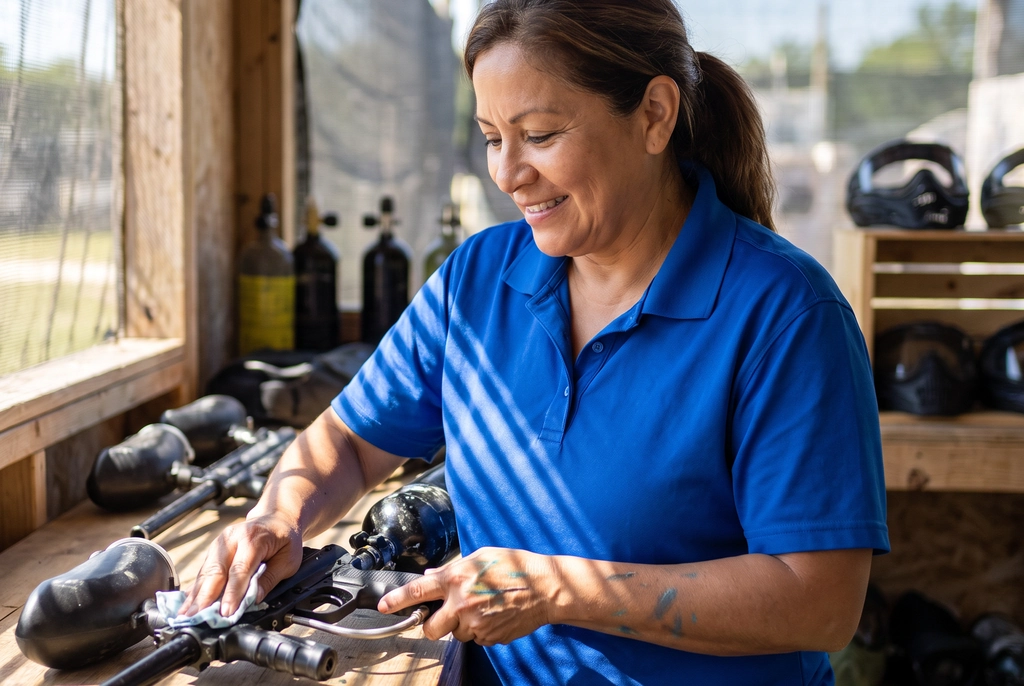
Buy mid-range rental markers from the start. Cheap off-brand markers fail more often, drive up repair costs, and frustrate first-time players who leave bad reviews. Reliable models like the Tippmann 98 Custom run $100 to $150 each and last multiple seasons with basic maintenance.
Indoor fields cost more upfront because of building lease, climate control, and ventilation, but they run year-round without weather downtime. Outdoor fields cost less to start but lose revenue in winter and rainy months. Most new owners start outdoor and expand indoor only after the first field hits consistent capacity.
How do you plan and validate a paintball business idea?
Validating a paintball business means researching local demand, checking competitor pricing, and confirming your startup budget covers 6 months of operations. Skip this step and you risk opening a field nobody in your area wants.
Research your local demand first. Visit nearby fields to see who plays. Are they casual renters for parties or serious tournament players? Check online forums like PbNation to understand player discussions and preferences in your region. This helps you tailor your field to the right audience.
Many new owners assume one game type fits all. Your local market may strongly prefer woodsball over speedball, which directly impacts your field design. Analyzing your competition on Google Maps and their websites reveals their pricing, packages, and gaps you can fill.
Here are 3 immediate steps to take:
- Identify and visit at least two local competitors to analyze their operations.
- Draft a preliminary budget breaking down field, equipment, and administrative costs.
- Talk to 20 local players to gauge interest in game types and price points.
What legal structure and licenses does a paintball field need?
A paintball field needs a registered business entity, a federal tax ID, a general business license, and a conditional use permit for the land. Most owners form an LLC because it separates personal assets from business liabilities.
Most new field owners form a Limited Liability Company (LLC). This structure separates your business and personal assets. If a legal issue arises, your personal property like your home is protected. You can file for an LLC through your state's Secretary of State website for about $50 to $500, depending on your state. Source: SBA guide to choosing a business structure.
An S Corporation is another option that can reduce self-employment taxes, but it requires more complex accounting and payroll management. Mixing personal and business bank accounts removes your liability protection, so open a dedicated business bank account immediately after forming your LLC.
First, get a free Employer Identification Number (EIN) from the IRS. You will need this for taxes and banking. While there is no specific federal paintball license, your equipment must meet ASTM International safety standards. Your local city or county planning department is your next stop.
You will need a general business license and likely a special or conditional use permit for your land, which can take 1 to 3 months to approve. If you sell gear or snacks, you also need a seller's permit from your state's tax agency. Permit costs vary from $50 to over $1,000.
Here are 3 immediate steps to take:
- File for an LLC or other business entity with your Secretary of State.
- Apply for a free Employer Identification Number (EIN) on the IRS website.
- Contact your local planning and zoning office to ask about land use permit requirements.
What insurance does a paintball business need?
A paintball field needs general liability insurance with at least $1 million per occurrence and $2 million aggregate, plus property insurance and workers' compensation if you hire staff. Annual premiums for a new field typically range from $7,000 to $15,000 based on quotes from amusement insurance brokers.
Your primary policy is general liability. You will need coverage of at least $1 million per occurrence and $2 million aggregate. Annual premiums for a new field often range from $7,000 to $15,000, a significant part of your operating budget. These figures reflect typical quotes from specialty amusement insurance brokers, not published rate sheets. Get at least three quotes before binding a policy.
Work with a broker who specializes in amusement insurance. General insurance agents rarely understand paintball's unique risks, which include projectile injuries, slip and fall on uneven terrain, and equipment malfunction. A specialty broker finds policies that properly cover your operations and often secures better rates.
Get quotes from providers like Cossio Insurance Agency, K&K Insurance Group, or American Specialty. These companies have deep experience with paintball fields. You will also need property insurance for your gear and workers' compensation if you hire staff.
Your liability waiver is your first line of defense. Have a lawyer draft it to ensure it is enforceable in your state. Generic online templates often fail to provide real protection when challenged in court.
Your insurer will expect you to enforce strict safety rules. This includes mandatory mask-on policies in all play and staging areas and chronographing every marker to ensure it shoots below the field's velocity limit, typically 280 feet per second.
Here are 4 immediate steps to take:
- Contact a broker who specializes in amusement or sports insurance.
- Request quotes from providers like Cossio Insurance Agency or K&K Insurance Group.
- Have a lawyer draft a state-specific liability waiver for your field.
- Write down your field's safety rules, including mask and chronograph policies.
How do you find a location and buy equipment for a paintball field?
A paintball field needs 5 to 10 acres for an outdoor setup, zoned for commercial recreation, plus 50 rental marker sets and a commercial air compressor. Land lease and rental gear together make up 60% or more of your startup budget.
You need at least 5 to 10 acres for a decent outdoor field. This provides space for play zones, parking, and a staging area. Check with your local planning department for land zoned for commercial recreation or a similar use classification.
When you find a spot, aim for a 3 to 5 year lease with renewal options. Discuss noise and traffic with the landlord upfront and get written permission for all planned activities to prevent future disputes.
Your biggest equipment expense is rental packages and your air fill system. Plan for at least 50 rental setups to start. Off-brand gear leads to frequent repairs and lost revenue on busy weekends.
| Equipment | Cost range | Notes |
|---|---|---|
| Rental markers | $100 to $150 each | Tippmann 98 Custom or equivalent mid-range model |
| Masks | $25 to $40 per mask | Must meet ASTM F1776 eye protection standard |
| CO2 or HPA tanks | $30 to $50 per tank | Budget for 50 to match rental sets |
| Air compressor and fill station | $5,000 to $15,000 | Required for high-volume weekend play |
Work with established distributors like ANSgear. They offer new field packages that simplify your first order and cost less than buying items one by one.
Here are 4 immediate steps to take:
- Identify three potential land parcels zoned for recreational use.
- Contact a commercial real estate agent about land lease terms.
- Request new field package quotes from a major paintball distributor.
- Draft a detailed equipment list and budget for 50 rental packages.
How do you set up payment processing for a paintball field?
A paintball field needs to accept card payments at the check-in counter and on the field for extra paintballs and air fills. Look for a processor with clear pricing, no monthly fees, and no hardware rental, since traditional terminals cost $200 to $600 plus software fees.
Most fields accept cash and cards. For large groups like corporate events or birthday parties, take a deposit upfront to secure the booking. This is typically a percentage of the total package price, collected when they reserve their spot.
You need a system that handles payments at your check-in counter and on the move for things like extra paintballs. Many new owners get locked into solutions with high monthly fees or expensive hardware. Look for clear pricing and flexibility.
For a paintball business that needs to accept payments on-site or on-the-go, JIM offers a streamlined solution. With JIM, you accept debit, credit, and digital wallets directly through your smartphone. Just tap and you are done.
At 1.99% per transaction with no hidden costs or extra hardware needed, it is particularly useful for taking payments anywhere on your property. Other providers often charge 2.5% to 3.5% plus monthly fees, so the savings add up quickly. For more detail on how mobile payment options compare, see this guide to mobile payment solutions for small businesses.
- Get Started: Download the JIM app for iOS.
- Make a Sale: Type the sales amount, hit sell, and ask your customer to tap their card or device on your phone.
- Access Funds: Your money is available right on your JIM card as soon as the sale is done. No waiting for bank transfers.
Here are 3 immediate steps to take:
- Decide on your deposit policy for group bookings.
- Compare payment processing rates, looking for fees below 2.5%.
- Download the JIM app to see how it works on your phone.
How do you fund a paintball business and manage finances?
A paintball field can fund startup costs through SBA 7(a) loans, equipment financing, or personal savings. The SBA 7(a) program caps interest rates based on loan size, and lenders typically look for a personal credit score of 680 or higher, though the SBA itself sets no universal minimum.
For a larger loan, the SBA 7(a) program is a solid option. Banks want to see a strong business plan and good credit. Many SBA-approved lenders look for a personal credit score of 680 or higher, though the SBA does not publish a universal minimum and individual lenders set their own benchmarks.
You could secure $50,000 to $150,000 through the program. Maximum interest rates are tiered by loan amount: Prime plus 6.5% for loans of $50,000 or less, Prime plus 6.0% for $50,001 to $250,000, Prime plus 4.5% for $250,001 to $350,000, and Prime plus 3.0% for loans above $350,000. Source: SBA 7(a) loan program.
If you just need funds for gear, equipment financing is an alternative. Approval is often faster than a bank loan, though interest rates can run 8% to 15%. This lets you finance your markers and air compressor separately without a huge upfront cash payment.
Plan your cash flow with a 6-month buffer. You should have enough cash on hand to cover at least six months of operating expenses without any income. This buffer covers rent, insurance, payroll, and utilities, which could mean having $30,000 to $60,000 set aside.
Under-budgeting for paint inventory catches new owners off guard. You need enough paintballs for several busy weekends, not just opening day. Running out of paint disappoints customers and loses future bookings.
Here are 4 immediate steps to take:
- Finalize your business plan with detailed financial projections.
- Contact your bank to discuss the SBA 7(a) loan application process.
- Calculate your 6-month operating budget to determine your working capital needs.
- Get quotes from two equipment financing companies for your gear purchase.
Is a paintball business profitable?
A paintball field can be profitable, with most operators reaching break-even in 18 to 36 months. Profit depends on three revenue drivers: group bookings, paintball markup, and repeat play.
Your real money-maker is paintballs. The markup on paint is substantial. A case of 2,000 paintballs might cost you $20 wholesale and sell to players for $60 to $80. This is where you generate most of your profit, not from entry fees. Treat paint pricing as your primary margin lever and track it weekly.
Group bookings drive predictable revenue. Corporate events and birthday parties book in advance, pay deposits, and fill weekday slots that would otherwise sit empty. A field running at 80% capacity on weekends and 30% on weekdays is on track to break even within 2 to 3 years.
Track your customer return rate and equipment failure rate monthly. Aim for a customer return rate above 25% and keep your equipment failure rate below 5% on any given weekend. These are operational benchmarks based on industry field performance, not published survey data, so adjust them to your local market.
How do you hire a team and set up operations?
A paintball field needs at least one full-time field manager and several part-time referees. Payroll typically runs 25% to 35% of total revenue, so staff for weekend peaks and scale down on weekdays.
Your team is the face of your business. You will need at least one Field Manager to run daily operations, with a typical salary of $35,000 to $50,000. You will also need several part-time Referees who manage games and enforce safety. They usually earn $15 to $20 per hour plus tips.
Understaffing on weekends is a common problem. Plan for one referee for every 15 to 20 players to ensure safety and a good experience. Prioritize candidates with strong customer service skills, even if they are new to paintball.
Proper training is non-negotiable. Require all staff to have First Aid and CPR certification. For your equipment tech, look into manufacturer-specific certifications, as this can reduce downtime on your rental fleet. A well-trained team prevents accidents and keeps customers happy.
Use software to manage your staff. Scheduling apps like Homebase help organize shifts. For customer reservations, booking platforms like FareHarbor or Bookeo can automate deposits and prevent overbooking. This frees you up to focus on running the field, not the calendar.
Your payroll will likely be 25% to 35% of your total revenue. This is a standard benchmark for service-based businesses and helps you forecast your finances accurately. Keeping this ratio in mind prevents over-hiring as you grow.
Here are 4 immediate steps to take:
- Draft job descriptions for a Field Manager and Referee.
- Schedule a First Aid and CPR certification course for yourself and future staff.
- Explore scheduling software like Homebase to see how it fits your needs.
- Create a basic safety and game rules script for new referees to learn.
How do you market a paintball business?
A paintball field markets itself through a Google Business Profile, action-oriented social media content, and local partnerships with corporate HR departments and youth groups. A reasonable customer acquisition cost for a new group booking is $25 to $50.
Start with your Google Business Profile. It is free and the first thing people see when they search paintball near me. Encourage your first customers to leave reviews, as a high rating directly impacts your visibility and bookings.
Use social media to show the experience, not just the gear. Posting static photos of markers does not sell the sport. Post action videos on Facebook and Instagram that capture the excitement of a game. This is what sells.
Reach out to corporate HR departments to pitch team-building packages. Offer a 10% discount on their first event to get them in the door. Also, connect with local schools and youth groups for birthday party deals. These partnerships provide consistent weekend traffic.
Track your spending as you market. A reasonable Customer Acquisition Cost (CAC) for a new group booking is around $25 to $50. If a $100 Facebook ad brings in three groups, your CAC is about $33. This simple math tells you what works.
Here are 4 immediate steps to take:
- Set up and fully complete your Google Business Profile with photos and hours.
- Create a social media content calendar for your first month of operations.
- Draft an email template to send to local corporate HR departments.
- Calculate your target Customer Acquisition Cost for group bookings.
How do you set pricing and packages for a paintball field?
A paintball field uses a package model, with a basic package at $30 to $40 and a premium package at $50 to $60. Paintballs carry a 300% to 500% markup and drive most of the profit.
Most fields use a package model. A basic package might be $30 to $40 for entry, a rental marker, a mask, and 500 paintballs. A premium package could be $50 to $60 and include extra paint or a chest protector. This simplifies choices for new players and groups.
Your real money-maker is paintballs. The markup on paint is substantial. A case of 2,000 paintballs might cost you $20 wholesale, but you can sell it to players for $60 to $80. This is where you generate most of your profit, not from entry fees.
Do not just copy your competitors' prices. Analyze their offerings on their websites and find a gap. Offer a mid-tier package they lack or include a free smoke grenade with group bookings to stand out.
For groups of 10 or more, offer a 10% to 15% discount per player. Corporate packages can be a flat rate, like $500 for up to 15 players for a private three-hour session. This predictable revenue is great for your cash flow.
Here are 4 immediate steps to take:
- Research the pricing of three local competitors.
- Calculate your target markup for a case of 2,000 paintballs.
- Draft a basic and a premium rental package with price points.
- Decide on a discount structure for groups of 10 or more.
How do you maintain quality and scale a paintball business?
A paintball business maintains quality by enforcing ASTM F1776 mask standards and ASTM F1979 paintball standards, then scales by adding staff and play zones when the field hits 80% capacity for three straight months.
Your reputation depends on consistent quality. All your masks must meet ASTM F1776 standards for eye protection, and paintballs should meet ASTM F1979 for projectile safety. Create a weekly checklist to inspect every marker and mask. Letting maintenance slide during busy seasons quickly hurts the customer experience.
Track key metrics to measure performance. Aim for a customer return rate above 25% and keep your equipment failure rate below 5% on any given weekend. These operational benchmarks reflect field-level performance, not published survey data, so calibrate them against your own results over the first year.
Once your operations are smooth, look at expansion. A good rule of thumb is to hire a new referee for every 15 to 20 additional players you consistently host. When your field hits 80% capacity for three straight months, plan a new play zone.
Reinvest 10% to 15% of your profits back into the business each quarter. This ensures you can afford new bunkers or upgrade your rental fleet. As you grow, booking software like Bookeo or FareHarbor becomes vital to manage the increased volume without errors.
Here are 4 immediate steps to take:
- Create a weekly equipment maintenance checklist based on ASTM standards.
- Start tracking your customer return rate and equipment failure rate monthly.
- Set your capacity benchmark (e.g., 80% booking) to trigger expansion planning.
- Allocate a percentage of profits for quarterly equipment upgrades in your budget.
The player experience is everything. A well-run game and a great atmosphere build your reputation faster than anything else. If you want to go deeper on the overall startup process, this guide to starting a small business walks through the 12-step framework that applies to any field, including paintball.
As you get your operations running, you will need a simple way to handle payments. JIM lets you accept cards right on your smartphone for a flat 1.99% fee, with no extra hardware. Download JIM and you are set for your first customers.
Frequently Asked Questions
How much does it cost to start a paintball business?
What permits does a paintball field need?
How much insurance does a paintball business need?
Is a paintball business profitable?
How much land do you need for a paintball field?



Sell and get paid in seconds with Jim