How to start a body oil business: a founder's guide
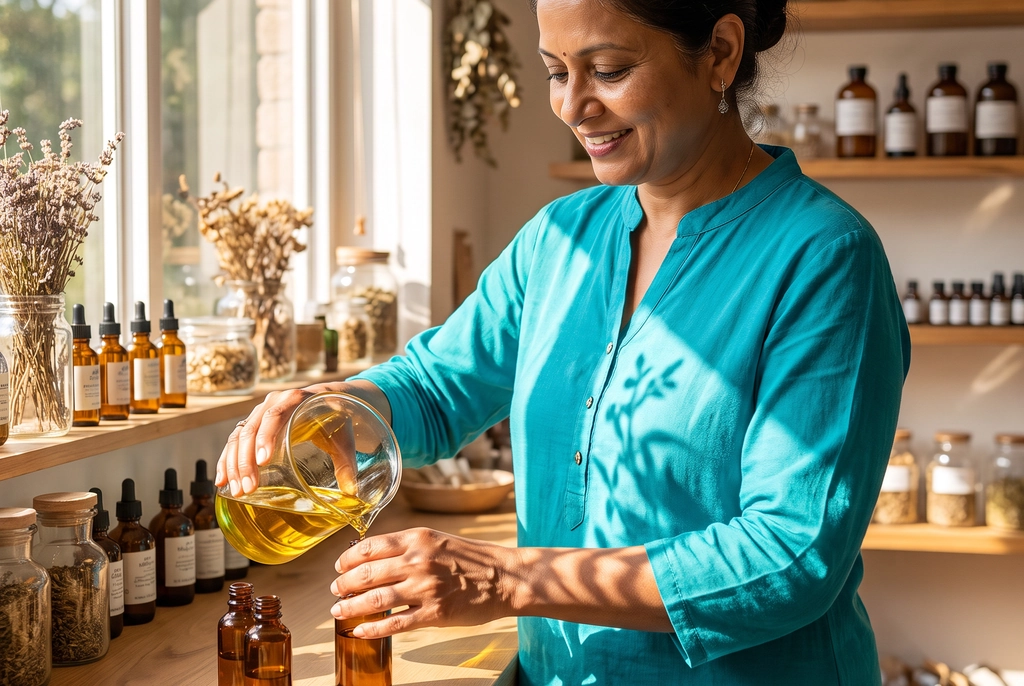
See article summary
- Plan to spend $1,500 to $7,000 to launch a home-based body oil business in the U.S.
- Form an LLC, get a free EIN from the IRS, and register your facility under MoCRA.
- Label products under the FPLA and 21 CFR Part 701 using INCI ingredient names.
- Start with cost-plus pricing at 3x to 5x your COGS for a 60% to 80% gross margin.
- Accept in-person payments at a flat 1.99% per sale with no extra hardware.
Starting a body oil business is a rewarding venture that combines a passion for natural ingredients with business savvy. The market is quite accessible thanks to the rise of e-commerce and a growing interest in wellness, but that accessibility also creates a competitive landscape.
You will need roughly $1,500 to $7,000 in startup capital, an LLC, FDA-compliant labeling under MoCRA, and four to six weeks to launch legally in the U.S. The steps below cover idea validation, licensing, insurance, sourcing, payments, funding, hiring, marketing, pricing, and quality control.
Step 1: How do you plan and validate your body oil business idea?
Define your market niche
Start by researching your specific customer. Use Google Trends to compare the search interest for different ingredients like jojoba oil versus argan oil. Browse forums like Reddit's r/skincareaddiction to find what problems customers want to solve.
Many new owners try to appeal to everyone. Instead, focus your research on a specific niche like body oils for sensitive skin or ethically sourced vegan oils. This focus makes your marketing and product development much clearer from the start.
Analyze competitors and set prices
Identify your top three to five competitors on platforms like Etsy, Amazon, or Instagram. Use a tool like Similarweb to estimate their website traffic. Analyze their product descriptions, pricing, and customer reviews to find gaps you can fill in the market.
Estimate your startup costs
Create a detailed budget. Initial startup costs for a small-scale body oil business typically range from $1,500 to $7,000, based on typical line-item ranges for home-based beauty startups. This accounts for ingredients and packaging ($500 to $2,000), business registration ($100 to $500), and website development ($300 to $1,500). These ranges are illustrative starting points; your actual costs depend on your ingredient quality, packaging choices, and whether you outsource web design.
Here are 3 immediate steps to take:
- Define a target customer and a specific product niche.
- Analyze three direct competitors' pricing and product offerings.
- Create a detailed startup budget using the cost categories provided.
Step 2: How do you set up your legal structure and get licensed?
Choose your business structure
Form a Limited Liability Company (LLC). It separates your personal assets from business debts, offering protection if things go wrong. LLC filing fees range from $35 to $500 depending on your state, with most states falling between $50 and $200. Source: U.S. Small Business Administration, Choose your business structure.
Once your LLC is approved, apply for a free Employer Identification Number (EIN) from the IRS. You will need this number for business banking and taxes. An LLC allows for pass-through taxation, meaning business profits are reported on your personal tax return.
Navigate regulations and licensing
The Food and Drug Administration (FDA) regulates cosmetics, but it does not require pre-market approval for body oils. Your responsibility is to ensure your products are safe for consumers and properly labeled. Two federal rules apply: the Fair Packaging and Labeling Act (FPLA) and FDA cosmetic labeling regulations at 21 CFR Part 701. Source: FDA, Cosmetics Labeling Guide. The same framework applies if you start an essential oil business, since both product categories fall under FDA cosmetic rules.
Since the Modernization of Cosmetics Regulation Act of 2022 (MoCRA), the rules have changed. Cosmetic product facilities must register with the FDA and renew every two years, and the responsible person must list each marketed product. The FDA began enforcing these requirements on July 1, 2024. Small businesses may qualify for exemptions from facility registration and product listing, but those exemptions do not apply to products that regularly come into contact with mucous membranes or to products with identified safety concerns. Source: FDA, Registration & Listing of Cosmetic Product Facilities and Products.
INCI stands for International Nomenclature of Cosmetic Ingredients, the standardized naming system FDA labeling rules expect on your ingredient list. Use INCI names (for example, "Simmondsia Chinensis Seed Oil" rather than "jojoba oil") to stay compliant and make your product recognizable to retailers and regulators.
Avoid marketing your oils with medical claims like "cures eczema." This action legally reclassifies your product as a drug, subjecting it to intense FDA scrutiny. Stick to cosmetic claims such as "hydrates skin" or "improves skin texture."
You will also need a general business license from your city or county. Costs and processing times vary, but expect to pay around $50 to $150 and wait a few weeks. Some areas may also require a home-based business permit if you operate from your residence.
Here are 4 immediate steps to take:
- File for an LLC with your state's Secretary of State office.
- Apply for a free Employer Identification Number (EIN) on the IRS website.
- Review the FDA's cosmetic labeling guide to ensure compliance.
- Contact your city clerk's office about a local business license.
Step 3: How do you secure insurance and manage risk?
Understand your coverage needs
Get General Liability insurance, which often includes Product Liability coverage. This is your safety net if a customer has an allergic reaction. Based on typical quotes from small-business insurers, a policy with $1 million in coverage commonly runs between $400 and $900 annually. Treat this range as a planning estimate and request actual quotes, since premiums vary by location, sales volume, and product formulation.
Consider whether you need other policies beyond General Liability. If you store significant inventory, Property insurance protects your stock from theft or fire. Use your car for deliveries? You may need a Commercial Auto policy. Workers' Compensation is only necessary once you hire employees.
Find a specialized provider
Look for insurers that understand the beauty industry. Providers like Hiscox, NEXT Insurance, and Veracity Insurance Solutions have experience with small e-commerce businesses and can offer tailored policies. A general agent might not grasp the specific risks associated with cosmetic products.
Beyond insurance, you can manage risk directly on your product. Clear ingredient lists and a simple instruction to perform a patch test on the skin before full use can help prevent adverse reactions and potential claims. This simple step shows you care about customer safety.
Here are 4 immediate steps to take:
- Request a quote for a General Liability policy that includes Product Liability coverage.
- Evaluate if you need Property or Commercial Auto insurance for your setup.
- Compare policies from specialized providers like Hiscox or NEXT Insurance.
- Review your product labels to include clear ingredient lists and patch test advice.
Step 4: How do you set up your workspace and source equipment?
Secure your production space
Most body oil businesses start at home. You will need a dedicated area of about 100 to 150 square feet. Check your local zoning regulations for a home-based business permit. A quick call to your city clerk's office can provide clarity on any specific rules.
If you choose a commercial space, look for properties zoned for light industrial or commercial use. When you negotiate a lease, ask for a one or two-year term. This gives you flexibility as your business grows without a long-term commitment.
Gather your equipment and supplies
You can assemble your production setup for under $250. Get a digital scale ($20 to $50) for accurate measurements and a set of glass beakers ($30 to $60). A stainless steel pot and a handheld immersion blender ($70 to $150 combined) work well for mixing and heating.
Use glass or stainless steel mixing containers. Some plastics can leach into your oils and compromise purity. This simple choice protects your product quality from the start.
For ingredients, look at suppliers like Bramble Berry or Bulk Apothecary. Many offer starter kits with no minimum order quantity (MOQ). As you scale, you can access wholesale pricing, which may require minimum orders of $100 or more, depending on the supplier.
Here are 4 immediate steps to take:
- Contact your city clerk about home-based business zoning.
- Price out a startup equipment kit with a digital scale and glass beakers.
- Research ingredient suppliers like Bramble Berry and compare their MOQs.
- If you explore commercial leases, ask about short-term options.
Step 5: How do you set up payment processing for your body oil business?
If you sell online, platforms like Shopify or Squarespace have built-in payment processors. For in-person sales at markets or pop-ups, you need a way to accept cards on the spot. This is where your choice of processor matters.
Traditional payment processors typically charge between 2.5% and 3.5% per sale, and some add monthly fees or hardware costs that can eat into your profits. Mobile card readers commonly charge around 2.6% flat, while online payment gateways often run 2.9% plus $0.30 per transaction. For a deeper comparison of credit card processing options for small businesses, the deciding factor is your effective rate, not the headline percentage alone.
For body oil businesses that need to accept payments on-site or on-the-go, JIM offers a streamlined solution. With JIM, you can accept contactless payments directly through your smartphone, just tap and done. It is a simple way to manage debit, credit, and digital wallet sales without extra equipment.
At just 1.99% per transaction with no hidden costs, it is particularly useful for selling at craft fairs or local markets. This rate is competitive when you compare it to other options. Here is how it works:
- Get Started: Download the JIM app for iOS.
- Make a Sale: Type the sales amount, hit sell, and ask your customer to tap their card or device on your phone.
- Access Funds: Your money is available right on your JIM card as soon as the sale is done, no waiting for bank transfers.
Here are 3 immediate steps to take:
- Compare the transaction fees of your e-commerce platform's default processor.
- Download the JIM app to prepare for in-person sales.
- Decide if you will focus on online sales, in-person events, or a mix of both.
Step 6: How do you fund your business and manage finances?
Secure your startup capital
Explore an SBA Microloan. These loans range from $500 to $50,000 and are offered through nonprofit community lenders. Interest rates typically fall between 8% and 13%, with repayment terms of up to seven years. They are a good fit for new businesses without a long credit history. Source: SBA, Microloans.
Another option is Kiva, which offers 0% interest crowdfunded loans up to $15,000. This path works well if you have a strong brand story that can rally community support. Many new owners try for large bank loans too early, so starting with these smaller options is often more practical.
Plan your financial runway
Calculate your working capital for the first six months. A budget of $3,000 to $10,000 is a realistic target. This amount should cover inventory replenishment, initial marketing campaigns, and other operational costs while you build sales momentum.
You can also look for grants. The Amber Grant for Women awards funds to female entrepreneurs, and the Grants.gov database lists federal opportunities. Grants are highly competitive, so be sure your application is polished and meets all criteria precisely.
Here are 4 immediate steps to take:
- Research SBA Microloan lenders in your state.
- Calculate your working capital needs for the first six months.
- Review the eligibility requirements for a Kiva loan.
- Search the Grants.gov database for small business grants.
Step 7: How do you hire staff and set up operations?
As orders increase, you will reach a point where you cannot do everything alone. This is the time to consider your first hire. Start with part-time help to manage costs while you scale, focusing on roles that free up your time.
Your first hires and systems
A Production Assistant can take over bottling, labeling, and packing for $15 to $20 per hour. While no specific certifications are required, experience with Good Manufacturing Practices (GMP) is a plus. You could also find a part-time Marketing Coordinator for $20 to $30 per hour.
Always create an employment agreement that details pay and duties to prevent misunderstandings, even when hiring friends. This step protects both you and your new hire, and it keeps the relationship professional.
Aim to keep payroll costs between 15% and 20% of your gross revenue. For scheduling, apps like Homebase or When I Work simplify time tracking. Also, document every formula and process in Google Docs to make training straightforward.
Here are 4 immediate steps to take:
- Draft a job description for a part-time Production Assistant.
- Calculate a hiring budget based on 15% of your projected revenue.
- Document the step-by-step process for creating one of your main products.
- Compare features of scheduling apps like Homebase and When I Work.
Step 8: How do you market your products and acquire customers?
Build your digital footprint
Focus your efforts on visual platforms like Instagram and TikTok. Create short videos that show your oil's texture or application. A good goal is to aim for a 2% to 3% engagement rate on your posts. This shows your content connects with your audience.
Beauty and skincare content tends to perform well with demonstration hooks: a three-second texture close-up, a before-and-after application, or a behind-the-scenes batching video. These formats consistently outperform static product photos in the beauty niche because they let buyers see consistency and feel the product before purchase.
You should also build an email list with a platform like Klaviyo. Offer a 10% discount to new subscribers as an incentive. A healthy email open rate in the beauty industry is around 20%, so use that as your benchmark for success.
Drive traffic with partnerships and ads
Collaborate with micro-influencers who have 10,000 to 50,000 followers. Smaller creators often have more engaged communities than huge accounts. Start by offering free products in exchange for a post or story.
Once you have some traction, test paid ads on Meta platforms. A small budget of $10 to $20 per day is enough to start. A reasonable Customer Acquisition Cost (CAC) for new beauty brands is between $25 and $50.
Here are 4 immediate steps to take:
- Plan one week of video content for Instagram or TikTok.
- Identify five micro-influencers in your niche to contact.
- Set up a Klaviyo account and create a welcome email with a discount.
- Outline a Meta ad campaign with a $15 daily budget.
Step 9: How do you price your products for profit?
Choose your pricing model
A simple way to start is with cost-plus pricing. First, calculate your Cost of Goods Sold (COGS) per bottle, which includes ingredients, the bottle, and the label. A typical markup in the beauty space is 3x to 5x your COGS. For example, if your COGS is $5, you might price your oil between $15 and $25.
Here is a worked COGS breakdown for a 2 oz body oil at three retail price points:
| Component | Cost per unit |
|---|---|
| Carrier oils and actives | $2.50 |
| 2 oz glass bottle + dropper | $1.20 |
| Label and packaging | $0.80 |
| Fulfillment (box, tape, pick) | $0.50 |
| Total COGS | $5.00 |
| Retail price | Markup on COGS | Gross margin |
|---|---|---|
| $18 | 3.6x | 72% |
| $24 | 4.8x | 79% |
| $32 | 6.4x | 84% |
This markup should give you a gross profit margin of 60% to 80%, which you need to cover marketing, overhead, and your own salary. Pricing too low to compete can signal lower quality and make it difficult to sustain your business.
You could also consider value-based pricing. If your oil uses rare ingredients or targets a specific high-value problem like "reducing the appearance of scars," you can command a higher price. Look at what premium brands charge for similar benefits, not just similar ingredients.
Analyze the competition
Create a simple spreadsheet to track the prices of your top five competitors on platforms like Etsy or in specialty retail stores. Note their product sizes, packaging, and any perceived unique selling points. This analysis helps you position your product without simply copying others.
Here are 4 immediate steps to take:
- Calculate the total COGS for one bottle of your signature body oil.
- Set a target retail price using a 3x to 5x markup on your COGS.
- Research the prices of five direct competitors for a similar-sized product.
- Decide if a cost-plus or value-based model fits your brand best.
Step 10: How do you control quality and scale your operations?
Establish your quality standards
Adopt principles from Good Manufacturing Practices (GMP), and where possible, current Good Manufacturing Practices (cGMP), the FDA's stricter standard for regulated manufacturing. This means you keep a sanitized workspace, document every formula, and assign batch numbers to your products. It is a great way to build trust and ensure consistency from the start.
Keep a small, labeled sample from each production batch. This makes it possible to investigate if a customer reports an issue. Also, track your quality with a simple metric like your customer complaint rate, and aim for less than 1% of all orders.
Know when to scale
Once you consistently process 50 to 75 orders per week, it is a strong signal to hire part-time help. This frees you to focus on marketing and growth. Another trigger is when you spend more than five hours a week just on manual inventory counts.
At that point, look at inventory management software. Systems like Katana or inFlow help you track raw materials and finished products. This prevents overselling or running out of a key ingredient unexpectedly. They often integrate directly with e-commerce platforms like Shopify.
Here are 4 immediate steps to take:
- Create a simple GMP checklist for your production process.
- Set up a system to retain a sample from each product batch you make.
- Define the weekly order volume that will trigger hiring your first assistant.
- Explore inventory management software like Katana or inFlow.
Starting a body oil business is about more than just mixing ingredients. The real value is in the story you tell and the specific problem you solve for your customer. You have the roadmap, so trust your vision and take that first practical step.
As you get ready for those first sales at local markets, remember that JIM turns your smartphone into a card reader. It helps you accept payments easily with no extra hardware at a flat 1.99% fee. Download JIM and you're ready to sell.
Frequently Asked Questions
Do you need FDA approval to sell body oils?
Is a body oil business profitable?
How much does it cost to start a body oil business?
Do I need an LLC to sell body oils?
What insurance do I need for a body oil business?



Sell and get paid in seconds with Jim