How to start a water ice business: a founder's playbook

See article summary
- A water ice cart launches for $10,000 to $30,000: cart, batch freezer, permits, and inventory.
- Water ice (Italian ice) is a dairy-free frozen dessert strongest in Pennsylvania, New Jersey, and New York.
- Plan 30 to 90 days for a county health permit before you can sell your first cup.
- A solo cart can gross $2,000 a week at peak; a $3 average ticket at 80 cups a day clears roughly $14,000 a season.
- Form an LLC, get a free EIN, and line up general liability insurance before day one.
A single water ice cart can gross $2,000 a week at summer festivals, but 30 to 90 days of county health permitting stands between you and day one. Below are the startup cost ranges, permit timelines, equipment math, and margin numbers you need to launch a mobile frozen dessert vendor in the U.S.
Water ice, also called Italian ice, is a dairy-free frozen dessert made from water, sugar, and fruit or flavoring mixed into the base before freezing. Federal standards in 21 CFR 135.160 define water ices by this composition. The treat has deep roots in the mid-Atlantic: Sicilian immigrants brought a granita-style dessert to Philadelphia in the late 1800s, and the term "water ice" is still strongest across Pennsylvania, New Jersey, and New York. The U.S. dessert store market reached $20.4 billion in revenue in 2024 at a five-year compound annual growth rate of 3.3%, so demand for cold, portable treats is steady.
How do you validate a water ice business concept?
Validation takes about two weekends of foot-traffic counts and a competitor sweep within five miles of your target spots. Visit local parks, community pools, and festival grounds on sunny days. Count foot traffic and observe which frozen desserts people actually buy. That real-world signal beats any online report, and the same field-research approach applies to any mobile food business.
Next, map your competition. Use Google Maps to list every frozen dessert vendor in your target area, then review their social media for popular flavors, pricing, and customer reviews. A common oversight is ignoring indirect competitors like ice cream shops, snow cone stands, and grocery store pints.
Estimate your startup costs
Budgeting for your initial investment keeps expectations realistic. A cart or kiosk runs $3,000 to $10,000. A commercial batch freezer is your largest purchase, often $5,000 to $15,000. Plan for another $1,000 to $3,000 in initial inventory.
Add licenses and a point-of-sale system, and your total initial outlay lands between $10,000 and $30,000 depending on scale and equipment choices.
| Item | Low | High | Notes |
|---|---|---|---|
| Cart or kiosk | $3,000 | $10,000 | Used carts cut this in half |
| Commercial batch freezer | $5,000 | $15,000 | Emery Thompson and Taylor are common brands |
| Dipping cabinet | $2,000 | $5,000 | Holds product at serving temperature |
| Initial inventory | $1,000 | $3,000 | Bases, cups, spoons, flavorings |
| Permits and licenses | $300 | $1,000 | Varies by county and state |
| Insurance (first year) | $300 | $700 | General liability, $1M coverage |
| Commissary deposit | $500 | $1,500 | First month at a shared kitchen |
| Total | $12,100 | $36,700 | Depends on new vs. used gear |
This week's checklist:
- Scout three potential locations during peak hours to count foot traffic.
- Use Google Maps to list all competitors within a five-mile radius.
- Build a preliminary budget with the cost ranges above.
How do you set up your legal structure and get licensed?
Form an LLC, get a free EIN from the IRS, then pursue your county health permit first because it has the longest lead time. Most new water ice vendors choose a Limited Liability Company (LLC). This structure protects personal assets like your home and car if the business faces a lawsuit, and it is a straightforward setup for a solo operator.
Once your LLC is registered with your state, get an Employer Identification Number (EIN) from the IRS. You need this for taxes and banking, even without employees. The application is free and takes minutes.
Secure your permits and licenses
With your business entity formed, you can pursue licenses. You need a state seller's permit to collect sales tax and a local business license to operate in your city or county. These are relatively quick to obtain.
Your most important document is the health permit from your county health department. The process can take 30 to 90 days and cost between $200 and $1,000, with fees set county by county, so start early. Contact your local health department for the exact fee schedule and inspection checklist before you apply.
Health departments often require you to use a licensed commissary kitchen for prep, storage, and cart cleaning. Find one and get a contract before you submit your health permit application, because they will ask for it.
Before you move on:
- File for an LLC with your state's Secretary of State office.
- Apply for a free EIN on the IRS website.
- Request the mobile food vendor packet from your local health department.
How much does insurance cost for a water ice cart?
General liability insurance with $1 million in coverage starts around $299 a year for a food vendor, with broader policies running higher. General liability is your top priority. It covers claims if a customer gets sick or injured, and most event organizers and commissaries require proof of this policy before you can set up.
Specialist providers publish their pricing openly. The Food Liability Insurance Program (FLIP) lists food vendor general liability starting at $25.92 a month or $299 a year. Established carriers like The Hartford and Hiscox also serve mobile food vendors and can tailor a policy to your operation.
If you use a vehicle exclusively for your business, you need a commercial auto policy. Once you hire your first employee, you must get workers' compensation insurance, a state requirement that covers employee injuries on the job.
Understand your specific risks
Beyond customer slips, your main risks are food contamination and equipment failure. Overlooking equipment breakdown coverage is a costly gap. If your commercial freezer dies overnight, this add-on can cover the cost of lost inventory, which could save you thousands.
Before you move on:
- Request a general liability insurance quote with $1 million in coverage.
- Ask potential insurers about adding equipment breakdown coverage.
- Compare policies from at least two providers that specialize in food businesses.
How do you choose a location and buy equipment?
Your commissary kitchen is your operational base for a mobile cart; for a storefront, look for 500 to 800 square feet zoned commercial. For a mobile cart, find shared-use kitchens on sites like The Kitchen Door. Expect to pay $500 to $1,500 a month for access to prep space, storage, and cleaning facilities.
If you plan a storefront, look for spaces zoned for commercial use. A small footprint of 500 to 800 square feet is plenty. When you negotiate a lease, ask for a few months of free rent to offset your build-out time. This is a common concession.
Acquire your gear
Your batch freezer is the heart of the operation. A new commercial unit from a brand like Emery Thompson costs $5,000 to $15,000. A dipping cabinet to hold and serve your product runs another $2,000 to $5,000.
Some new owners try to use residential freezers, but health departments require NSF-certified equipment for commercial food service. NSF certification verifies that equipment meets sanitation standards for materials, design, and cleanability. For flavor bases, suppliers like I. Rice & Co. are industry standards. They may have a minimum order of one or two cases, so plan your initial purchase accordingly.
Before you move on:
- Research three local commissary kitchens and compare their monthly rates.
- Get quotes for a new commercial batch freezer from two different suppliers.
- Browse flavor base options from a supplier like I. Rice & Co. to understand minimum orders.
How do you set up payment processing for a water ice cart?
You need to accept credit, debit, and digital wallet payments, and card speed at the cart directly drives sales volume. Most customers no longer carry cash, especially at parks or festivals.
Choose your payment solution
When you review payment solutions, look at transaction fees. Many providers charge between 2.5% and 3.5% per sale and may require you to buy or rent a separate card reader. These costs add up for a new business, so compare your in-person payment options before you commit to a processor.
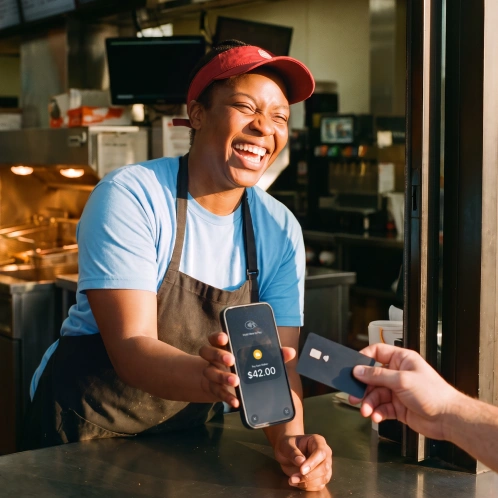
For a water ice cart that needs to accept payments on-site or on-the-go, JIM offers a streamlined solution. With JIM, you accept debit, credit, and digital wallets directly through your smartphone. Just tap and you are done.
At 1.99% per transaction with no hidden costs or extra hardware needed, it is particularly useful for mobile carts at events where speed matters. For larger catering gigs, you can also create a simple one-page agreement that outlines the total cost and requires a 50% deposit to secure the date.
Here is how to use it:
- Get Started: Download the JIM app for iOS.
- Make a Sale: Type the sales amount, hit sell, and ask your customer to tap their card or device on your phone.
- Access Funds: Your money is available right on your JIM card as soon as the sale is done, with no waiting for bank transfers.
Before you move on:
- Compare the transaction fees of two traditional payment processors.
- Download the JIM app to explore its interface.
- Draft a simple deposit agreement for future catering inquiries.
How do you fund a water ice business and manage finances?
An SBA Microloan fits a new water ice cart well: loans run up to $50,000 through nonprofit intermediary lenders, with interest rates generally between 8% and 13%. Many new owners fund their launch with personal savings. If you need outside capital, the SBA Microloan program is a strong fit. The SBA caps these loans at $50,000, the average loan is about $13,000, and the maximum repayment term is seven years. SBA-approved intermediary lenders make all credit decisions and set their own underwriting criteria, so ask your local microlender about their minimum credit score and business plan requirements.
Another route is equipment financing, which lets you borrow specifically for your batch freezer or cart. This can be easier to qualify for since the equipment itself serves as collateral.
Calculate your working capital
You need cash on hand for your first six months. Plan for $5,000 to $10,000 in working capital. This covers recurring costs like inventory, commissary rent, insurance, and fuel. Keep a contingency fund of at least 15% of that amount for unexpected repairs or slow sales days, a principle that applies to starting any small business.
This buffer handles surprises without derailing your business. Track every expense from day one using simple accounting software like Wave or a dedicated spreadsheet. This makes tax time much simpler and shows you where your money is going.
Before you move on:
- Check your personal credit score through a free service.
- Draft a six-month operating budget including a 15% contingency fund.
- Identify two SBA-approved microlenders that serve your area.
How do you hire and run daily operations?
Your first hire is a Cart Operator at $15 to $20 per hour plus tips, and they need a food handler's card before their first shift. This person handles serving, payments, and daily cleaning. You can post the job on local community boards or food-focused Facebook groups.
Before they start, they must get a food handler's card, which is required by most health departments. The online course and test usually cost around $15. Train them on portion control from day one, since inconsistent scoops quietly erode profit. Create a simple photo guide for consistency.
Set up your daily workflow
For scheduling, apps like Homebase or When I Work have free plans for small teams. They let you build schedules and track hours from your phone, which simplifies payroll and communication for event-based shifts.
As a practical benchmark, one person can typically handle about $250 in sales per hour at a steady festival pace. If you anticipate crowds that exceed this, schedule a second person to manage the line and payments. This prevents long waits and lost sales.
Before you move on:
- Draft a job description for a Cart Operator with a clear pay range.
- Check your local health department's website for food handler's card rules.
- Create a free account on a scheduling app like Homebase to explore its features.
- Make a one-page portioning guide with photos for training new staff.
How do you market a water ice cart?
Claim a free Google Business Profile, post your weekly location, and use Instagram and Facebook to show off your product. Start with a free Google Business Profile. Add high-quality photos of your water ice and cart. This makes you appear in local map searches. Also, secure social media handles on Instagram and Facebook. These platforms are perfect for visual products.
Post your weekly location schedule so customers can find you. Aim for 3 to 4 posts a week to keep your audience engaged, and use polls to ask about new flavor ideas.
Focus on local outreach
Your cart is a mobile billboard, so make sure your branding is clear and attractive. For customer retention, use a simple punch card system. A "buy nine, get one free" offer encourages people to come back.
Look into local partnerships. Contact schools or youth sports leagues and offer to give back 15 to 20% of sales for fundraisers. Also, create a simple catering package for office parties and birthdays. This can become a reliable source of income, especially when you pair it with the right payment methods for small businesses to handle both walk-up and catering sales.
Before you move on:
- Set up a Google Business Profile with your hours and photos.
- Design a "buy 9, get 1 free" punch card.
- Draft an email to a local school about a fundraiser partnership.
- Post your upcoming weekly schedule on your social media pages.
How do you price water ice for profit?
Aim for a food cost percentage between 20% and 30%, which means a small cup that costs $0.75 to make sells for $2.50 to $3.75. First, calculate your cost per serving. Add up the price of the water ice base, flavor, cup, and spoon for each size you plan to offer. Forgetting the cost of paper goods is a frequent mistake.
Set your menu prices
A small at $3, a medium at $4, and a large at $5 is a common tiered model. This simple structure encourages customers to upgrade for just a dollar more, which boosts your average transaction value.
Check your local market
With your target prices in mind, visit at least two other frozen dessert shops in your area. Note their prices for comparable sizes. If your prices are much higher, you need a clear reason, like premium ingredients. If they are too low, you may leave money on the table.
Is a water ice business profitable?
A worked example shows the math. Suppose a solo cart sells 80 cups a day at a $3 average ticket across a 120-day season. That is $28,800 in gross revenue. After COGS at roughly 25%, commissary rent, insurance, fuel, and permit fees, a solo operator can clear about $14,000 in net profit for the season. Add catering gigs at $500 to $1,500 per event, and the upside grows.
Before you move on:
- Calculate the total cost for one small cup, including the cup and spoon.
- Price a small cup to achieve a 25% food cost percentage.
- Visit two competitors and record their prices for small, medium, and large sizes.
- Create a simple price menu with three size options.
How do you maintain quality and scale a water ice business?
Hold your dipping cabinet between 15 and 20 degrees Fahrenheit, taste each flavor daily, and expand to a second cart only after your first one hits a consistent weekly sales target. Consistency is what brings customers back. Create a daily quality checklist. It should include tasting each flavor for freshness and checking that your dipping cabinet holds the product between 15 and 20 degrees Fahrenheit. Foodservice references identify this range as ideal for Italian ice storage and service; colder temperatures freeze the product solid, and warmer temperatures melt it. This prevents ice crystals from forming and protects texture.
Many new owners let standards slide once they get busy. To avoid this, train your team on the checklist from day one. Also, track customer feedback from reviews and social media comments. This gives you direct insight into product quality.
Know when to grow
Use clear data to guide your expansion. Once your first cart consistently brings in over $2,000 in weekly sales for a full month, you can start planning for a second one. The math supports it: $2,000 a week across a 16-week season is $32,000 in gross revenue. At a 25% net margin, that is $8,000 in profit, enough to fund a second $6,000 cart within a single season. This shows you have a proven concept and stable demand.
When one person is handling over $250 in sales per hour, it is time to add a second team member to that shift. For managing inventory across multiple locations, look into software like MarketMan to track your supplies.
Before you move on:
- Create a daily quality control checklist covering taste, texture, and temperature.
- Set a weekly sales goal that would trigger plans for a second cart.
- Log all customer feedback for one week to spot quality patterns.
- Research an inventory management system like MarketMan.
Where is water ice most popular, and do permits vary by state?
Water ice is most popular in Pennsylvania, New Jersey, and New York, and permit fees and timelines vary by state and county. The treat traces its roots to Sicilian immigrants who arrived in Philadelphia in the late 1800s, and the term "water ice" is still strongest across the mid-Atlantic. If you launch in Pennsylvania, New Jersey, or New York, expect a mature customer base that already knows the product.
Permit specifics differ by jurisdiction. Pennsylvania and New Jersey both require a state food establishment license plus a county health permit for mobile vendors. Florida regulates frozen dessert manufacturing under its Department of Agriculture and Consumer Services. Always confirm the exact fee schedule, inspection checklist, and processing time with your county health department before you apply, because a permit valid in one county may not be valid in the next.
Your 30-60-90 day launch timeline
- Days 1 to 30: Form your LLC, get your EIN, file for your state seller's permit, and submit your county health permit application. Order your batch freezer and dipping cabinet. Secure a commissary kitchen contract.
- Days 31 to 60: While your health permit processes, buy your cart, stock initial inventory, and get general liability insurance. Build your menu, set your pricing, and claim your Google Business Profile.
- Days 61 to 90: Pass your health inspection, finalize your commissary setup, and run a soft launch at a low-risk event. Train your first hire on portioning and the quality checklist. Download JIM to accept card payments from day one.
To keep that service smooth, you want a simple way to take payments. JIM turns your phone into a card reader, so you can accept payments anywhere for a flat 1.99% fee with no extra hardware. Download JIM and you are ready for your first sale.
Frequently Asked Questions
How much does it cost to start a water ice business?
How profitable is a water ice business?
What permits do I need to sell water ice?
Is water ice the same as Italian ice?
What temperature should water ice be stored at?



Sell and get paid in seconds with Jim